|
 |
 |
 |
 |
 |
 |
 |
 |
 |

| . |  |
. |
Mars Reconnaissance Orbiter Nears End of Aerobraking
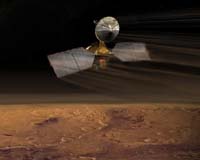
Pasadena CA (JPL) Aug 29, 2006 NASA's Mars Reconnaissance Orbiter has begun the final and fastest-paced portion of its "aerobraking" process of using friction with the top of Mars' atmosphere to shrink the spacecraft's orbit. After nearly 400 drag passes into the atmosphere during the closest-to-Mars portion of each orbit, the spacecraft has reduced the farthest point in its orbit to an altitude of 1,100 kilometers (684 miles). The spacecraft takes 2 hours, 7 minutes to complete one orbit, as of Aug. 25. In contrast, during the weeks between Mars Reconnaissance Orbiter's arrival at Mars on March 10 and its start of aerobraking in early April, the most distant point of each orbit was about 43,000 kilometers (27,000 miles) away from the planet and each orbit lasted about 35 hours. By using the aerobraking technique, the project has saved carrying 600 kilograms (about 1,300 pounds) of additional propellant to the red planet. "We are in the end-game part of aerobraking from now until August 30, when we will fire our thrusters to move the spacecraft out of an atmosphere-grazing orbit," said Mars Reconnaissance Orbiter Project Manager Jim Graf, of NASA's Jet Propulsion Laboratory, Pasadena, Calif. "Because of the variations in the atmosphere and the short orbits, this period is the most exciting and most dangerous of the five months of aerobraking. The team is on '24-seven' until the 30th." The lowest-altitude part of each drag pass has been about 100 kilometers (62 miles), varying by a few percent up or down due to gravitational variations in the lumpy planet and as adjusted by small maneuvers that keep the right balance between atmospheric drag and heating as the spacecraft flies through the variable atmosphere. On each of the aerobraking passes, the spacecraft records the density of the atmosphere on both the inbound and outbound legs as it flies through its closest approach to the planet. This information is used to characterize atmospheric variability, which helps guide the flight team to design the right maneuvers. The data will also be analyzed to understand the structure and circulation of the upper atmosphere. The desired orbit for systematic observations by the spacecraft's six scientific instruments ranges from an altitude of 320 kilometers (199 miles) over Mars' north pole to an altitude of 255 kilometers (158 miles) over the south pole, a loop that takes one hour and 53 minutes to fly. The flight team plans to get the spacecraft's orbit into that size and shape by mid-September, with two maneuvers to raise the low-altitude portion of the orbit following completion of the aerobraking that is lowering the high-altitude portion. The mission's main science observations are scheduled to begin in November, after a period of intermittent communications while Mars passes nearly behind the sun. As the flight team manages the end-game aerobraking, engineers are also studying a stuck waveguide transfer switch in the orbiter's X-band radio communication system. This switch allows one of the spacecraft's two X-band amplifiers to transmit through either the low-gain antenna, which has a broad field-of-view, or the high-gain antenna, a dish antenna 3 meters (10 feet) in diameter that is used to downlink high-rate science data. The present spacecraft operation is stable and allows for the full amount of science data to be transmitted to Earth. The stuck switch limits the flexibility of choosing which amplifier is used to transmit data. Engineers are conducting tests to understand the root cause of the switch becoming stuck and to explore possibilities for restoring the operability of the switch. Related Links Mars Reconnaissance Orbiter  Spirit Continues Mid-Winter Studies Of Martian Rocks And Soil
 Pasadena CA (SPX) Aug 27, 2006
Spirit continued to make progress on the rover's winter campaign of science observations, acquiring microscopic images and data about rock composition with the alpha particle X-ray spectrometer and the miniature thermal emission spectrometer. Spirit took images of the spacecraft deck for incorporation into the "McMurdo panorama." |
|
|

| The content herein, unless otherwise known to be public domain, are Copyright 1995-2006 - SpaceDaily.AFP and UPI Wire Stories are copyright Agence France-Presse and United Press International. ESA PortalReports are copyright European Space Agency. All NASA sourced material is public domain. Additionalcopyrights may apply in whole or part to other bona fide parties. Advertising does not imply endorsement,agreement or approval of any opinions, statements or information provided by SpaceDaily on any Web page published or hosted by SpaceDaily. Privacy Statement |