 |
 |
 |
 |
 |
 |
 |
 |
 |
 |

| . |  |
. |
Mercury Messenger Probe Flips Sunshade Towards The Sun
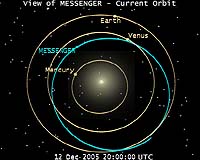
Laurel MD (SPX) Jun 23, 2006 The Messenger spacecraft performed its final "flip" maneuver for the mission on June 21. Responding to commands sent from the Messenger Mission Operations Center at The Johns Hopkins University Applied Physics Laboratory (APL) in Laurel, Md., through NASA's Deep Space Network antenna station near Goldstone, Calif., the spacecraft rotated 180 degrees, pointing its sunshade toward the Sun. The 16-minute maneuver, designed to keep Messenger operating at safe temperatures as it moves closer to the Sun, wrapped up at 9:34 a.m. EDT, with successful reacquisition of signal from Messenger's front-side antenna. The spacecraft was 196.5 million kilometers (122.1 million miles) from Earth and 144.6 million kilometers (89.8 million miles) from the Sun when the maneuver occurred. Messenger had been flying with its back to the Sun since a March 8 "flop," allowing it to maintain temperatures within safe operating ranges at Sun distances greater than 0.95 astronomical units (1 AU is Earth's distance from the Sun). Mission plans call for the spacecraft to keep its sunshade facing the Sun for the remainder of its cruise and science orbital operations around Mercury. "Initial indications look very good" says Messenger Mission Operations Manager Mark Holdridge, of APL. "Spacecraft temperatures are coming down as expected and all systems and instruments are nominal." The team will now turn its attention to preparing for the first Venus flyby on October 24. "We have mission simulations and flight tests coming up to test particular operations that will have to occur during the Venus flyby," Holdridge says. "There will be a 57-minute solar eclipse during the October operation, so we will so be testing the flight systems in the flyby configuration to verify they will behave properly during the eclipse period." On August 11, for instance, the team will conduct a flight test of the new autonomy that will power off components prior to the solar eclipse, allow the battery to discharge by approximately the same amount as during the real eclipse, and then power on components again once the battery is recharged, all in a more controlled setting with real-time visibility. This test will be combined with a battery reconditioning. Later in August and through September, during the approach to Venus, Messenger's navigation team will use the Mercury Dual Imaging System cameras onboard the spacecraft to take a series of optical navigation pictures. These images are not required for the Venus flyby but will be used by the Messenger navigation team for calibration and as practice for the optical navigation imaging to be utilized at Mercury.
Mercury Science: From Mariner 10 to Messenger It takes hard work and the dedication of scores of individuals to make Messenger run smoothly � and through the remainder of the mission we'll introduce you to the Instrument, Engineering and Science Team members who make this mission happen. First up is Robert G. Strom, a founder of modern planetary geology, an expert in surface morphology, and the only person on the Messenger team to have also served on the first mission to Mercury, Mariner 10. As a member of the Science Team's Geology Group, he will lead the analysis of Mercury's geologic history and participate in the analysis of Mercury Atmospheric and Surface Composition Spectrometer spectral measurements of the surface. He's just finished writing a book about global warming. Find out more by going to Related Links Mercury Messenger Mercury Messenger Team  Early Mercury Impact Showered Earth
 Leicester, England (SPX) Apr 05, 2006
New computer simulations of Mercury's formation show some of the resulting ejected material ended up on Earth and Venus. The simulations, which track the material's path over several million years, also shed light on why Mercury is denser than expected. |
|
|

| The content herein, unless otherwise known to be public domain, are Copyright 1995-2006 - SpaceDaily.AFP and UPI Wire Stories are copyright Agence France-Presse and United Press International. ESA PortalReports are copyright European Space Agency. All NASA sourced material is public domain. Additionalcopyrights may apply in whole or part to other bona fide parties. Advertising does not imply endorsement,agreement or approval of any opinions, statements or information provided by SpaceDaily on any Web page published or hosted by SpaceDaily. Privacy Statement |