|
 |
 |
 |
 |
 |
 |
 |

| . |  |
. |

|
|
. |

 by Staff Writers Los Angeles CA (SPX) Oct 13, 2011
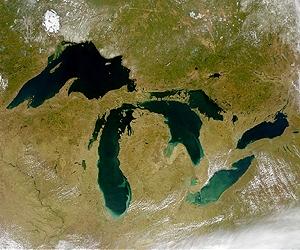
The scope and intensity of mercury pollution in the Great Lakes region is much greater than previously reported, but additional mercury controls should bring needed improvement, according to a new summary of scientific research on the subject. Despite general declines in mercury levels in the Great Lakes region over the past four decades, mercury concentrations still exceed human and ecological risk thresholds, especially in inland lakes and rivers, according to the report Great Lakes Mercury Connections: The Extent and Effects of Mercury Pollution in the Great Lakes Region, published in Springer's journal Ecotoxicology. Also, new research indicates that for some species of fish and wildlife in particular areas, mercury concentrations may again be on the rise. While the risk of elevated mercury concentrations to human health is well known-all of the Great Lakes states and the province of Ontario issued fish consumption advisories due to high mercury-new studies cited in the report suggest that adverse effects of mercury on the health of fish and wildlife occur at levels much lower than previously reported. "The good news is that efforts to control mercury pollution have been very beneficial," says David C. Evers, Ph.D., executive director and chief scientist at Biodiversity Research Institute, and the principal investigator in the Great Lakes study. "However, as we broaden our investigations, we find that fish and wildlife are affected at lower mercury concentrations and across larger areas, and that impacts can be quite serious. For example, we found that estimated mercury concentrations in the blood of common loons were above levels that are associated with at least 22 percent fewer fledged young in large areas of the Great Lakes study region. "The report represents the work of more than 170 scientists, researchers, and resource managers who used more than 300,000 mercury measurements to document the impact and trends of mercury pollution on the Great Lakes region. A collaboration of the Biodiversity Research Institute in Gorham, Maine, the Great Lakes Commission based in Ann Arbor, Michigan, and the University of Wisconsin-La Crosse, the project is the product of a binational, scientific synthesis sponsored by the Commission through its Great Lakes Air Deposition Program, funded by the U.S. Environmental Protection Agency (EPA). "One of our core missions is to support the policymaking process with good science," says Tim Eder, executive director of the Great Lakes Commission. "This report represents a wealth of scientific knowledge developed by some of North America's leading experts in this field. It portrays the most accurate and well-documented picture yet of the impact of mercury contamination on the Great Lakes environment." The research details how mercury pollution is changing over time. "When we analyzed lake sediments, we were surprised to see such a strong connection between mercury loadings to the region and mercury emissions in the region," says Charles Driscoll, Ph.D., University Professor of Environmental Systems Engineering at Syracuse University and co-principal investigator on the project. "We documented a 20 percent decline in sediment mercury deposition from peak values around 1985. This decline was concurrent with a 48 percent decline in mercury emissions from sources in the Great Lakes region and a 17 percent increase in global emissions, clearly illustrating the benefit of controlling domestic emissions. It is likely that additional national and regional air emission controls would result in further declines in mercury contamination of the Great Lakes region as well as other areas of the U.S. and Canada." Among other findings, the report points out that the northern reaches of the Great Lakes region are particularly sensitive to mercury and that, despite improvements, fish mercury concentrations remain above the EPA human health criterion in these sensitive areas. "The decline in mercury contamination of fishery resources across much of the Great Lakes region is very welcome news," says James G. Wiener, Ph.D., Wisconsin Distinguished Professor at the University of Wisconsin-La Crosse, and co-principal investigator in the study. "However, the fish in many of the region's inland lakes and rivers exceed important human and environmental health thresholds. For instance, we looked at six commonly eaten game fish and found that average mercury concentrations in these fishes exceeded the EPA human health criterion in 61 percent of the study region." Dr. Wiener further noted that some long-term mercury trends appear to be changing. "The observations of recent increases in mercury concentrations in some fish and wildlife populations in the region is also cause for concern, because we do not understand why these increases are occurring." Atmospheric emissions are the primary source of mercury deposition in the Great Lakes basin; the report projects that further controls on those emissions "are expected to lower mercury concentrations in the food web, yielding multiple benefits to fish, wildlife, and people in the Great Lakes region. "Great Lakes Mercury Connections is being officially released today in Detroit at the Great Lakes Commission's 2011 Annual Meeting, and the opening day of the first-ever "Great Lakes Week" event. Great Lakes Week is bringing together representatives of the U.S. and Canadian governments along with public and private groups to focus on finding solutions to the most pressing environmental and economic challenges facing the lakes.
Great Lakes Commission Our Polluted World and Cleaning It Up
|
. |
|
| The content herein, unless otherwise known to be public domain, are Copyright 1995-2011 - Space Media Network. AFP and UPI Wire Stories are copyright Agence France-Presse and United Press International. ESA Portal Reports are copyright European Space Agency. All NASA sourced material is public domain. Additional copyrights may apply in whole or part to other bona fide parties. Advertising does not imply endorsement,agreement or approval of any opinions, statements or information provided by Space Media Network on any Web page published or hosted by Space Media Network. Privacy Statement |
 del.icio.us
 Digg
Digg Reddit
 Google