|
 |
 |
 |
 |
 |
 |
 |
 |
 |

| . |  |
. |
Michigan Telescopes Help Give Astronomers Insights Into Blazars
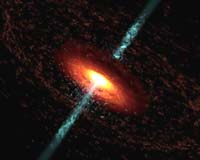
Ann Arbor MI (SPX) Apr 25, 2008 For the first time, astronomers have observed a blazar in action, substantiating a prevailing theory about how these luminous and energetic galactic cores work. A paper on the observations is published in the April 24 issue of Nature. Two University of Michigan astronomers contributed to the research, which was led by Alan Marscher of the Institute for Astrophysical Research at Boston University. Blazars, among the most energetic objects in the universe, are fueled by supermassive black holes at the core of certain giant elliptical galaxies. Periodically, they emit jets of high-energy plasma at almost the speed of light. Competing theoretical models sought to explain how this phenomenon occurs. One model predicted that the jets were propelled by magnetic fields that were twisted by the gravity of the black hole and the materials falling into it. This is the behavior the astronomers detected. "What we've observed is the mechanism by which the acceleration of relativistic particles in the emanating jets occurs. Knowing that mechanism enhances our understand of the physics that goes into the acceleration process," said Hugh Aller, a professor in the U-M Department of Astronomy. Relativistic particles are particles traveling close to the speed of light. "Often, we'd observe blazars, but they didn't do anything. It's been difficult to catch these outbursts when they occur," he added. Scientists from across the globe aimed a variety of telescopes at the blazar BL Lacertae, about 950 million light-years away from Earth. Optical, X-ray and radio telescopes monitored the galaxy at different electromagnetic wavelengths periodically for several years. U-M recorded radio light curves at the Radio Astronomy Observatory at Peach Mountain in Dexter. "This is the first observational evidence that really fits with the picture that the theoreticians have had," said Margo Aller, a research scientist and lecturer in the U-M Department of Astronomy. "The reason we have this evidence is a very fine sampling of a large number of instruments, including the Michigan radio telescopes." Scientists hope to get a closer look at blazar jets when NASA launches its Gamma-ray Large Area Space Telescope (GLAST) satellite observatory in May. Community Email This Article Comment On This Article Related Links Stellar Chemistry, The Universe And All Within It
 Stellar Birth In The Galactic Wilderness
 Pasadena CA (SPX) Apr 18, 2008
A new image from NASA's Galaxy Evolution Explorer shows baby stars sprouting in the backwoods of a galaxy -- a relatively desolate region of space more than 100,000 light-years from the galaxy's bustling center. The striking image, a composite of ultraviolet data from the Galaxy Evolution Explorer and radio data from the National Science Foundation's Very Large Array in New Mexico, shows the Southern Pinwheel galaxy, also known simply as M83. |
|
|

| The content herein, unless otherwise known to be public domain, are Copyright 1995-2007 - SpaceDaily.AFP and UPI Wire Stories are copyright Agence France-Presse and United Press International. ESA Portal Reports are copyright European Space Agency. All NASA sourced material is public domain. Additional copyrights may apply in whole or part to other bona fide parties. Advertising does not imply endorsement,agreement or approval of any opinions, statements or information provided by SpaceDaily on any Web page published or hosted by SpaceDaily. Privacy Statement |