
 Taiwan to check fishing grounds off Japan Taipei (AFP) May 2, 2011 - Taiwan sent a research vessel to waters off northern Japan Monday to determine whether it is safe to catch fish in the area amid concerns over the country's ongoing nuclear crisis. The government-owned "Fishery Researcher 1" was to conduct tests in waters east of Japan's northern Hokkaido island, the Council of Agriculture said in a statement, ahead of the traditional fishing season in the area. The waters are a major catching ground for Pacific saury, a knife-shaped fish popular with Taiwanese and Japanese diners. Food production has been suspended in the area near the Fukushima nuclear plant on Japan's northeast coast since shortly after a massive quake and tsunami on March 11 crippled the facility, leading to radiation leaks. The research ship will aim to establish whether the waters, which are around 750 kilometres (400 miles) from the plant, are safe for commercial fishing. The ship is scheduled to return on May 23, the council said.
|
The analysis from the Pacific island nation of Palau shows that sharks -- hunted worldwide for their fins, a Chinese delicacy -- are worth many times more to some local economies alive than dead.
"Sharks can literally be a 'million-dollar' species and a significant economic driver," said lead author Mark Meekan, a scientist at the Australian Institute of Marine Science.
"Our study shows that these animals can contribute far more as a tourism resource than as a catch target," he said in a statement.
Sharks have reigned at the top of the ocean food chain for hundreds of millions of years.
But because they mature slowly and produce few offspring, the consummate marine predators have proven vulnerable to industrial-scale fishing.
Tens of millions of the coastal and open-water sharks are harvested every year to supply a burgeoning appetite for meat and especially shark-fin soup.
The researchers found that the annual value to the Palau tourism industry of an individual reef shark at one of the country's major scuba-diving sites is 179,000 dollars (121,000 euros) a year, or about 1.9 million dollars (1.3 million euros) over the animal's lifetime.
Shark diving accounts for about eight percent of the tiny country's GDP and 14 percent of its business tax base. It also generates more than a million dollars annually in salaries.
In 2009, Palau became the first country in the world to declare all of its territorial waters to be a shark sanctuary, followed last year by Honduras and The Maldives.
The US state of Hawaii, the territories of Guam and the Northern Marianas, and the Republic of the Marshall Islands have all banned the possession, sale or distribution of shark fins.
"Shark tourism can be a viable economic engine," said Matt Rand, a shark expert at the Washington-based Pew Environment Group, which commissioned the research.
"This study provides a compelling case that can convince more countries to embrace these animals for their benefit to the ocean and their value to a country's financial well-being."
About a third of open-water sharks face extinction, according to the International Union for the Conservation of Nature (IUCN).
Regional studies have shown that when shark populations crash the impact cascades down through the food chain, often in unpredictable and deleterious ways.
 del.icio.us del.icio.us |
 Digg Digg |
 Reddit Reddit |
 YahooMyWeb YahooMyWeb |
 Google Google |
 Facebook Facebook |

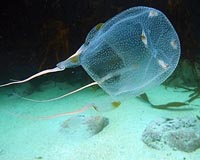 Box jellyfish look out to the world above the water
| The content herein, unless otherwise known to be public domain, are Copyright 1995-2010 - SpaceDaily. AFP and UPI Wire Stories are copyright Agence France-Presse and United Press International. ESA Portal Reports are copyright European Space Agency. All NASA sourced material is public domain. Additional copyrights may apply in whole or part to other bona fide parties. Advertising does not imply endorsement,agreement or approval of any opinions, statements or information provided by SpaceDaily on any Web page published or hosted by SpaceDaily. Privacy Statement |


