|
 |
 |
 |
 |
 |
 |
 |
 |
 |

| . |  |
. |
NASA Extends Thiokol Shuttle Booster Contract Through May 2007
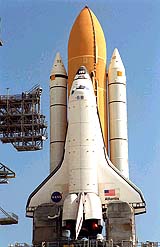
Huntsville - Jul 09, 2002 NASA has extended to May 2007 its six-and-a-half-year $2.4 billion contract with ATK Thiokol Propulsion in Brigham City, Utah, for the production and refurbishment of 70 Reusable Solid Rocket Motors for the Space Shuttle Program. Under the modified contract, Thiokol will produce and refurbish 35 Reusable Solid Rocket Motor flight sets (70 motors) and three flight support motors. The modification adds $429 million to the contract. The contract, issued in October 1998, is the sixth in a series of contracts for the design, development, production and refurbishment of Solid Rocket Motors for the Space Shuttle Program and represents a continuing relationship between NASA's Marshall Space Flight Center in Huntsville, Ala., and Thiokol. Marshall is home to the Space Shuttle's Reusable Solid Rocket Motor Project Office. At launch, the three Space Shuttle Main Engines and the two Reusable Solid Rocket Motors provide enough thrust to lift the 4.5-million-pound shuttle vehicle -- the propellant weighs 3.5 million pounds -- into orbit. The Shuttle's Reusable Solid Rocket Motor (RSRM) is the largest solid motor ever flown and the first designed for reuse. Each motor consists of four segments lined with 1.1 million pounds of solid fuel propellant. The forward segment holds an igniter. Two motors, each producing an average thrust of 2.6 million pounds during their 124-second burn, are used on each space shuttle flight. At burnout the shuttle has reached an altitude of 24 nautical miles and a velocity of more than 3,000 mph. After the propellant is depleted, the Solid Rocket Boosters, which house the motors, separate from the shuttle's orbiter and land in the ocean. The Solid Rocket Boosters are recovered and disassembled and the motors are returned to Thiokol. At Thiokol, the cases are cleaned, inspected and reassembled for propellant casting, and a new nozzle and igniter are installed. The motor's steel case components can be used as many as 20 times. Related Links SpaceDaily Search SpaceDaily Subscribe To SpaceDaily Express  Twenty Years And No Signs Of Running Out Of Gas
 Greenbelt - Jul 01, 2002
On June 27, 1982, Get Away Special No. 1 rocketed into space aboard Space Shuttle "Columbia" on STS-4. |
|
|

| The content herein, unless otherwise known to be public domain, are Copyright 1995-2006 - SpaceDaily.AFP and UPI Wire Stories are copyright Agence France-Presse and United Press International. ESA PortalReports are copyright European Space Agency. All NASA sourced material is public domain. Additionalcopyrights may apply in whole or part to other bona fide parties. Advertising does not imply endorsement,agreement or approval of any opinions, statements or information provided by SpaceDaily on any Web page published or hosted by SpaceDaily. Privacy Statement |