|
 |
 |
 |
 |
 |
 |
 |
 |
 |

| . |  |
. |
NASA Mega-Telescope Gears Up To Study Cosmos
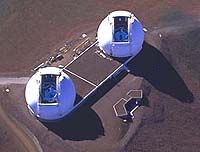
Washington DC (SPX) Dec 07, 2007 NASA has selected three teams of scientists to begin studying disks of dust around nearby stars starting in February 2008, using the Keck Interferometer in Mauna Kea, Hawaii. This sophisticated new system combines the observing power of the two large Keck telescopes into a single mega-telescope. The announcement follows completion of the Keck Interferometer's technology phase, in which its detectors, starlight trackers, active optics and computer control systems were installed, tested and integrated. Testing was conducted on stars, in the first on-sky demonstration of long-baseline nulling interferometry, a technique that "cancels" the bright light from the star to see fainter material around it.
The newly selected teams are led by the following principal investigators: The teams will study stars with known debris disks and look for signs of dust around other stars. Some debris disks are remnants from planet formation; others contain material kicked up when asteroids collide. Asteroid collisions in our solar system produce a disk of what's called "zodiacal dust." This can be seen when sunlight scatters small dust grains to produce a faint band of light visible against a dark sky just after sunset or before dawn. The Keck Interferometer science teams are looking for comparable, although much brighter, disks in other planetary systems. The Keck Interferometer links the Keck Observatory's two 10-meter (33-foot) telescopes. It is part of NASA's ongoing quest to search for planets orbiting other stars. JPL, a division of the California Institute of Technology in Pasadena, manages the Keck Interferometer for NASA. Community Email This Article Comment On This Article Related Links Keck Interferometer Stellar Chemistry, The Universe And All Within It
 UBC Astronomers Discover How White Dwarf Stars Get Their Kicks
 Vancouver, Canada (SPX) Dec 05, 2007
University of British Columbia astronomer Harvey Richer and UBC graduate student Saul Davis have discovered that white dwarf stars are born with a natal kick, explaining why these smoldering embers of Sun-like stars are found on the edge rather than at the centre of globular star clusters. |
|
|

| The content herein, unless otherwise known to be public domain, are Copyright 1995-2007 - SpaceDaily.AFP and UPI Wire Stories are copyright Agence France-Presse and United Press International. ESA Portal Reports are copyright European Space Agency. All NASA sourced material is public domain. Additional copyrights may apply in whole or part to other bona fide parties. Advertising does not imply endorsement,agreement or approval of any opinions, statements or information provided by SpaceDaily on any Web page published or hosted by SpaceDaily. Privacy Statement |