|
 |
 |
 |
 |
 |
 |
 |
 |
 |

| . |  |
. |
NASA Research Seeks To Discover If Comets Seeded Life
Greenbelt - Jul 18, 2003 NASA's Goddard Space Flight Center will lead the effort to discover if comets supplied the raw material for the origin of life on Earth, and if they could do so for alien worlds, as part of its participation in NASA Astrobiology Institute (NAI) research. NAI selected a team of scientists led by NASA Goddard for a five-year, multimillion-dollar research effort that will explore how organic molecules are created in interstellar clouds and delivered to planets as they form. The award is one of 12 new research awards announced by the Institute June 24. "One of the most interesting questions is also among the deepest: Where did we come from? I'm honored to be leading a team of so many recognized experts that will help answer this question," said Dr. Michael Mumma of NASA Goddard, Greenbelt, Md., who is the Principal Investigator for the NAI Goddard award. Organic molecules contain carbon atoms and are present in all life forms currently known to science. Simple organic molecules have been found in interstellar clouds. Observations indicate stars and planets are formed from interstellar cloud material when these clouds collapse under their own gravity. Astronomers believe organic molecules become more complex as they receive energy from the newborn star in the cloud. The new research will combine laboratory experiments, observations with ground-based telescopes and spacecraft, and missions to sample comet and asteroid material to discover how organic molecules are created in interstellar clouds and later are modified in the gas and dust disks around young stars.These disks, called protoplanetary disks, form when an interstellar cloud collapses. While collapsing interstellar clouds are busy building solar systems, lumps of ice and dust (comets) form in the cold, outer regions of the protoplanetary disk that surrounds a newly-forming sun. "Our team will investigate whether energetic radiation from the young star can modify the organic chemicals before they are incorporated into comets," said Mumma. Analogous to "dirty snowballs," comets trap large amounts of organic molecules in their ices as they form from a protoplanetary disk. Astronomers think the newly created Earth was subjected to a fierce bombardment of comets about four billion years ago, when the protoplanetary disk that created our solar system was thick with swarms of newborn comets. The rain of comets was so intense it could have supplied a large portion of the water in Earth's oceans. "Earth's new ocean probably was dirty, because it should have been full of organic molecules and dust particles carried to our planet by comets and primitive meteorites," said Mumma. "We want to learn how significant their contribution was to the genesis of life on Earth." The NAI research led by Goddard capitalizes on the Center's strengths in laboratory astrochemistry, planetary systems research, interstellar, stellar, planetary, and cometary spectroscopy (analysis of light), and spacecraft instrument development. The NAI is a virtual institute, in which collaborations and communication of results will be conducted by videoconferences over the Internet, as well as at scientific conferences. Workshops at Goddard and the University of Maryland, College Park will share results with educators and students under the Minority Institution Astrobiology Cooperative. The interdisciplinary team includes researchers in Earth science, space science, and instrument development at Goddard as well as scientists from around the country and the world. The new NAI research awards begin in fall 2003, when current agreements with the NAI's 11 founding lead teams conclude. NAI team awards are for five years, with annual reviews, at an average annual funding level of one million dollars. Institutions with scientific co-investigators include the University of Maryland, College Park, the California Institute of Technology, Pasadena, Calif., the Johns Hopkins University Applied Physics Laboratory, Laurel, Md., the SETI institute, Mountain View, Calif., Washington University, St. Louis, Mo., Eckerd College, St. Petersburg, Fla., the University of Massachusetts, Amherst, Mass., and the University of Washington, Seattle, Wash. Institutions with scientific collaborators include the Carnegie Institution of Washington, Washington, DC, NASA's Ames Research Center, Moffett Field, Calif., the University of California at Santa Cruz, The Catholic University of America, Washington, DC, and Rowan University, Glassboro, N.J. International collaborators include scientists from the University of Paris, France, and Leiden Observatory, The Netherlands. Related Links NASA Astrobiology Institute SpaceDaily Search SpaceDaily Subscribe To SpaceDaily Express  Searching For The Real Waterworld
 Paris (ESA) Jul 10, 2003
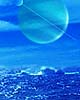
Science fiction writers and movie-makers have imagined a world completely covered by an ocean, but what if one really existed? Would such a world support life, and what would this life be like? |
|
|

| The content herein, unless otherwise known to be public domain, are Copyright 1995-2006 - SpaceDaily.AFP and UPI Wire Stories are copyright Agence France-Presse and United Press International. ESA PortalReports are copyright European Space Agency. All NASA sourced material is public domain. Additionalcopyrights may apply in whole or part to other bona fide parties. Advertising does not imply endorsement,agreement or approval of any opinions, statements or information provided by SpaceDaily on any Web page published or hosted by SpaceDaily. Privacy Statement |