|
 |
 |
 |
 |
 |
 |
 |
 |
 |

| . |  |
. |
NSF Partnership Funds Instrument For Worlds Largest Telescope
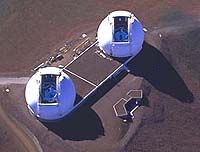
Kamuela, Hawai'i (SPX) May 26, 2006 The W. M. Keck Observatory and the National Science Foundation (NSF) announced that $5 million of NSF funding has been granted over the next four years to design and construct a major new capability for the Keck I telescope. It was also announced that a matching gift of $5 million from philanthropists Gordon and Betty Moore has been received to complete full funding for the project to build an infrared, multi-object spectrograph to measure phenomena at the farthest reaches of the universe. The spectrograph will be operational by late 2009. The new instrument, known as the Multi-Object Spectrograph for InfraRed Exploration (MOSFIRE), is being developed through a collaborative team of scientists and engineers representing the Keck Observatory, University of California at Los Angeles, California Institute of Technology, and University of California at Santa Cruz. When operational, MOSFIRE will allow astronomers to study the first generation of galaxies formed shortly after the Big Bang 13.7 billion years ago. By simultaneously measuring up to forty infrared spectra, or cosmic "fingerprints," of distant galaxies, the instrument will be capable of undertaking ambitious sky surveys in a fraction of the time currently possible, surveys currently far too time consuming to even consider with today's technology. "At a time in our nation's history when public funding for basic research is far less than it needs to be to keep us competitive, it is especially encouraging that concerned private citizens are stepping forward," said Dr. Frederic H. Chaffee, director of the W. M. Keck Observatory. "The generosity of Gordon and Betty Moore will not only lead to many unexpected discoveries that may very likely transform our understanding of the early universe, it will also support our nation's continued leadership in science, technology and innovation." Moore is the co-founder and long-time CEO of Intel. The NSF funding for MOSFIRE was provided under the Telescope System Instrumentation Program (TSIP) which aims to provide access for U.S. astronomers to privately funded observatories such as Keck through a competitive application process. In exchange for funding for new instrumental capabilities under TSIP, observing time is made available to any U.S. astronomer whose project is approved by a panel of peers. "Our past funding of instruments at Keck has enabled just the kind of �system' of observatory collaborations that we envisaged when the TSIP program was inaugurated in 2002," said Dr. Todd Boroson, deputy director of the National Optical Astronomy Observatories in Tucson, AZ, which administers the TSIP program for NSF. "Astronomers who would otherwise not have access to the world's largest telescopes have benefited greatly from this program and have made U.S. astronomy much stronger as a whole." Dr. Wayne van Citters, director of the Division of Astronomical Sciences at the NSF, echoed these sentiments: "NSF Astronomy is the federal agency responsible for the stewardship of all ground-based astronomy at a time when other nations are challenging the leadership role in astronomical research that the United States has held for over a century. Programs like TSIP are aimed at leveraging all our scientific capabilities, both publicly or privately funded, and, by every measure, this still-young program has been very successful." Related Links WM Keck Observatory  Hubble Captures Quintuple Quasar Image
 Baltimore MD (SPX) May 23, 2006
The Hubble Space Telescope has captured the first-ever picture of a group of five star-like images of a single distant quasar. |
|
|

| The content herein, unless otherwise known to be public domain, are Copyright 1995-2006 - SpaceDaily.AFP and UPI Wire Stories are copyright Agence France-Presse and United Press International. ESA PortalReports are copyright European Space Agency. All NASA sourced material is public domain. Additionalcopyrights may apply in whole or part to other bona fide parties. Advertising does not imply endorsement,agreement or approval of any opinions, statements or information provided by SpaceDaily on any Web page published or hosted by SpaceDaily. Privacy Statement |