 |
 |
 |
 |
 |
 |
 |
 |
 |
 |

| . |  |
. |
New NASA Satellites Shipped To Launch Site
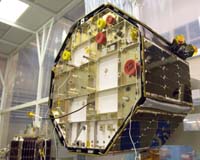
Vandenberg AFB CA (SPX) Dec 28, 2005 NASA 's Space Technology 5 (ST5) micro-satellites have arrived at the Vandenberg Air Force Base, Calif., launch site and are in the beginning stages of final launch preparation. ST5 is scheduled to launch in February 2006. "The team is very excited and we are still working hard as we approach our launch date," said Art Azarbarzin, ST5 Project Manager at NASA's Goddard Space Flight Center in Greenbelt, Md. ST-5 will pave the way for future science missions by demonstrating the benefits of a constellation of small low-cost spacecraft obtaining simultaneous measurements in different locations. The three ST5 satellites will fly on a planned 90-day mission. Miniaturized components and technologies are being integrated into each of the ST5 micro-satellites. Each micro-satellite weighs, about the size of a 13 inch television, are approximately 25 kilograms (55 pounds) when fully fueled and are 53 centimeters (20.7 inches) wide and 48 centimeters (18.7 inches) high. The three ST5 satellites will be launched using a Pegasus XL rocket and spun into a near-Earth polar elliptical orbit that will take them anywhere from 300 kilometers (190 miles) to 4,500 kilometers (2,800 miles) from Earth. Although small in size, each of ST5 satellites are considered "full service," meaning they contain power, propulsion, communications, guidance, navigation and control functions found in spacecraft that are much larger. Another unique feature as a result of the miniaturized size and reduced weight is the ability to launch multiple micro-satellites from a low-cost Pegasus XL rocket. The ST5 Project designed, fabricated and tested a new innovative Pegasus launch rack that supports the three micro-satellites in a "stacked" configuration. By utilizing this type of design, each micro-satellite will be individually deployed in a spinning (Frisbee-like) motion. Once in orbit, the ST5 micro-satellites will be placed in a row about 40-140 km (about 25-90 miles) apart from each other to perform coordinated multi-point measurements of the Earth's magnetic field using a highly sensitive miniaturized magnetometer built by University of California, Los Angeles. This type of measurement is useful for future Sun-Earth Connection missions that will study the effect of solar activity on the Earth's magnetosphere, a protective magnetic "bubble" that surrounds the planet and helps protect it from harmful space radiation. The Cold Gas Micro-Thruster (CGMT), built by Marotta Scientific Controls of Montville, N.J., will provide propulsion for orbit maintenance. The X-Band Transponder Communication System, built by Aero Astro of Chantilly, Va., will support two-way communications between the ST5 micro-satellites and the ground stations. Johns Hopkins University, Applied Physics Laboratory of Laurel, Md. along with Sensortex, Kennett Square, Pa and SANDIA National Labs, Albuquerque, NM., built the Variable Emittance Coatings for Thermal Control, which will test the ability to configure the thermal characteristics of a radiator surface on the micro sat. The University of Idaho, Center for Advanced Microelectronics and Bimolecular Research in Post Falls, Idaho, provided the Complementary Metal Oxide Semiconductor (CMOS) Ultra-Low Power Radiation Tolerant (CULPRiT) Logic, which provides a low-power (operating at 0.5 V) digital-logic test circuit that will help reduce power requirements for future satellites. Related Links ST5 SpaceDaily Search SpaceDaily Subscribe To SpaceDaily Express  Australian Defense Department Buys Defunded Science Satellite
 Canberra, Australia (SPX) Dec 27, 2005
Australia's Department of Defense will manage the country's only fully owned and operational satellite FedSat from January next year. |
|
|

| The content herein, unless otherwise known to be public domain, are Copyright 1995-2006 - SpaceDaily.AFP and UPI Wire Stories are copyright Agence France-Presse and United Press International. ESA PortalReports are copyright European Space Agency. All NASA sourced material is public domain. Additionalcopyrights may apply in whole or part to other bona fide parties. Advertising does not imply endorsement,agreement or approval of any opinions, statements or information provided by SpaceDaily on any Web page published or hosted by SpaceDaily. Privacy Statement |