|
 |
 |
 |
 |
 |
 |
 |
 |
 |

| . |  |
. |
New Understanding For Superconductivity At High Temperatures
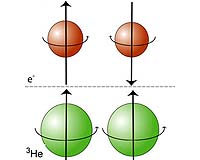
Montreal, Canada (SPX) Jan 14, 2008 An international research team has discovered that a magnetic field can interact with the electrons in a superconductor in ways never before observed. Andrea D. Bianchi, the lead researcher from the Universite de Montreal, explains in the January 11 edition of Science magazine what he discovered in an exceptional compound of metals - a combination of cobalt, indium and a rare earth - that loses its resistance when cooled to just a couple of degrees above absolute zero. "This discovery sharpens our understanding of what, literally, holds the world together and brings physicists one step closer to getting a grip on superconductivity at high temperatures. Until now, physicists were going around in circles, so this discovery will help to drive new understanding," said Prof. Bianchi, who was recruited to UdeM as a Canada Research Chair in Novel Materials for Spintronics last fall and performed his experiments at the Paul Scherrer Institute in Switzerland, in collaboration with scientists from ETH Zurich, the University of Notre Dame, the University of Birmingham, U.K., the Los Alamos National Laboratory and the Brookhaven National Laboratory.
Magnetic tornado that grows stronger "When subjected to intense magnetic fields, these materials produce a completely new type of magnetic tornado that grows stronger with increasing fields rather than weakening," said Prof. Bianchi. "The beauty of this compound is how we can experiment without breaking it." Superconductors hold great promise for technological applications that will change how modern civilization can store and transmit energy - arguably some of the most pressing challenges today. Other notable applications include superconducting digital filters for high-speed communications, more efficient and reliable generators and motors, and superconducting device applications in medical magnetic resonance imaging machines. The first superconductor was discovered nearly a hundred years ago, and in most materials this curious state with no resistance was shown to arise from the interaction of the electrons with the crystal; however, in this new material, superconductivity is thought to arise from magnetic interactions between electrons. Community Email This Article Comment On This Article Related Links University of Montreal Powering The World in the 21st Century at Energy-Daily.com
 Ireland to ban low-efficiency light bulbs
 Dublin (AFP) Jan 10, 2008
Ireland is to ban the sale of traditional light bulbs from next year and promote the use of low-energy CFL bulbs, environment minister John Gormley said Thursday. |
|
|

| The content herein, unless otherwise known to be public domain, are Copyright 1995-2007 - SpaceDaily.AFP and UPI Wire Stories are copyright Agence France-Presse and United Press International. ESA Portal Reports are copyright European Space Agency. All NASA sourced material is public domain. Additional copyrights may apply in whole or part to other bona fide parties. Advertising does not imply endorsement,agreement or approval of any opinions, statements or information provided by SpaceDaily on any Web page published or hosted by SpaceDaily. Privacy Statement |