|
 |
 |
 |
 |
 |
 |
 |
 |
 |

| . |  |
. |
New Window Into Ancient Ozone Holes
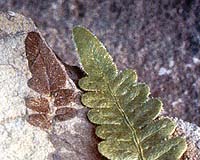
Calgary AB (SPX) Aug 10, 2005 British researchers have hit on a clever way to search for ancient ozone holes and their relationship to mass extinctions: measure the remains of ultraviolet-B absorbing pigments ancient plants left in their fossilized spores and pollen. To develop the approach, researcher Barry Lomax and his colleagues at the University of Sheffield and other leading UK institutions analyzed spores held in the British Antarctic Survey's collection from South Georgia Island, a UK territory in the far southwestern corner of the Atlantic Ocean. They discovered that since the 1960s, spores from living land plants have shown a three-fold increase in the concentration of UV-B absorbing pigments to protect themselves against a 14 percent decrease in stratospheric ozone, says Lomax. "We have initially been investigating whether plants of palaeobotanical significance are capable of adapting to changes in UV-B radiation," said Lomax. In particular, they studied the UV-B response of the club moss Lycopodium magellanicum, a native of South Georgia Island. "Now that this has been established we are investigating possible changes in terrestrial UV-B flux during the Permian-Triassic boundary (251 million years ago)," said Lomax. That boundary marks the largest mass extinction in the Earth's history and also coincides with the largest known eruption of lava and potentially ozone-destroying gases - the Siberian Traps. The latest results from the ongoing work will be presented by Lomax on Wednesday, 10 August, at Earth System Processes 2, a meeting co-convened by the Geological Society and Geological Association of Canada this week in Calgary, Alberta, Canada. The modern increase in UV-B at South Georgia is the direct result of high latitude springtime ozone destruction in the stratosphere caused by decades of releases of human-made chlorofluorocarbons (CFCs). The situation may have been the same a quarter billion years ago, except that the earlier ozone-destroying chemicals came from the Earth itself. "Volcanic eruptions can emit gases such as chlorine and bromine that are capable of destroying ozone," said Lomax. The heating of rocks near volcanic flows of the Siberian Traps may also release a wide range of organohalogens thought to be harmful to ozone, he said. The next step is to search for the chemical remains of the plant pigments in fossilized spores and pollen. "The pigments break down to form compounds that are stable over geological time," said Lomax, "so providing samples have not been subjected to large amounts of heat, the signature should be preserved." The research is funded by the UK's Natural Environment Research Council, with the specific aim of finding a way to measure ancient UV-B levels by combining experimental and palaeobotanical investigations. The Siberian Traps, Stratospheric Ozone, UV-B Flux, and Mutagenesis. Wednesday, 10 August, 10:00 a.m. MDT, Lakeview Endrooms, Calgary Westin Hotel. Abstract may be viewed at http://gsa.confex.com/gsa/2005ESP/finalprogram/abstract_88582.htm Related Links SpaceDaily Search SpaceDaily Subscribe To SpaceDaily Express  Solar Storms, Arctic Winds Swirl In A Double Dip Cone Of Ozone Loss
 Greenbelt MD (SPX) Jun 24, 2005
Solar storms, such as the unusually intense events in October and November 2003, affect many aspects of our lives, such as radio signals and satellite communications. |
|
|

| The content herein, unless otherwise known to be public domain, are Copyright 1995-2006 - SpaceDaily.AFP and UPI Wire Stories are copyright Agence France-Presse and United Press International. ESA PortalReports are copyright European Space Agency. All NASA sourced material is public domain. Additionalcopyrights may apply in whole or part to other bona fide parties. Advertising does not imply endorsement,agreement or approval of any opinions, statements or information provided by SpaceDaily on any Web page published or hosted by SpaceDaily. Privacy Statement |