|
 |
 |
 |
 |
 |
 |
 |
 |
 |

| . |  |
. |
Northrop Grumman Starts Integration And Test On LCROSS Spacecraft
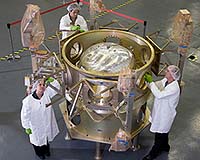
Redondo Beach CA (SPX) Dec 04, 2007 The satellite that will impact the Moon in 2009 in a search for water has started to come together in a manufacturing high bay at Northrop Grumman's Space Technology sector. The company is building the Lunar CRater Observation and Sensing Satellite (LCROSS) under contract to NASA Ames Research Center. Integration and test (I and T) on LCROSS started with preparations for installation of electrical harnesses, following installation of the propulsion subsystem. Work will continue over the next nine months as the spacecraft's subsystems and NASA-provided science payload are integrated onto the spacecraft structure and culminate in environmental testing next summer. The spacecraft will be delivered to NASA's John F. Kennedy Space Center in Florida late next summer, with launch scheduled in the winter 2008-2009 timeframe with impact occurring three months later. The impact will send a greater than 250-metric-ton plume higher than 10 kilometers from the Moon's surface that, given clear viewing conditions and an adequate telescope, should be visible from Earth by amateur astronomers. "This is a fast track program," said Steve Hixson, vice president for Advanced Concepts. "We're using existing technology to build the spacecraft quickly, with low risk and a limited budget. We expect to deliver the spacecraft just 27 months after the kick-off, in less than half the time of a traditional spacecraft development program." The primary structure for the LCROSS spacecraft is a central cylinder, known as an EELV Secondary Payload Adapter (ESPA), or ESPA ring. The ESPA ring is a six-foot-diameter ring with six portholes used to attach the secondary structure for the solar array and radiator panels. The spacecraft subsystems, science instruments and electronics are mounted onto the inside face of the panels. Each panel can be folded out to a 90-degree angle for easy access and subsystem installation. The modular structure allows subsystems to be integrated as they are received. The LCROSS spacecraft and avionics are being built by Northrop Grumman under contract to NASA Ames Research Center, Moffett Field, California. LCROSS will accompany the Lunar Reconnaissance Orbiter on an Atlas launch vehicle, and will search for water and water-bearing compounds at the lunar South Pole to determine if the location has the potential to support future human outposts. Community Email This Article Comment On This Article Related Links Lunar CRater Observation and Sensing Satellite (LCROSS) Mars News and Information at MarsDaily.com Lunar Dreams and more
 KAGUYA (SELENE) Composes 3-D Movies With Terrain Camera Images
 Tokyo, Japan (SPX) Nov 30, 2007
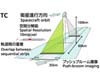
The Japan Aerospace Exploration Agency (JAXA) successfully demonstrated production of stereo movies (3 dimensional movies) of the Moon surface by using stereoscopic images obtained with the Terrain Camera (TC) onboard KAGUYA on Nov. 3, 2007 (Japan Standard Time, JST). This verification was performed as part of the initial check out of mission instruments onboard "KAGUYA" (SELENE), which was injected into the Moon's orbit at an altitude of about 100 km. |
|
|

| The content herein, unless otherwise known to be public domain, are Copyright 1995-2007 - SpaceDaily.AFP and UPI Wire Stories are copyright Agence France-Presse and United Press International. ESA Portal Reports are copyright European Space Agency. All NASA sourced material is public domain. Additional copyrights may apply in whole or part to other bona fide parties. Advertising does not imply endorsement,agreement or approval of any opinions, statements or information provided by SpaceDaily on any Web page published or hosted by SpaceDaily. Privacy Statement |