|
 |
 |
 |
 |
 |
 |
 |
 |
 |

| . |  |
. |
OSIRIS Camera On Rosetta Obtains Light Curve Of Asteroid Steins
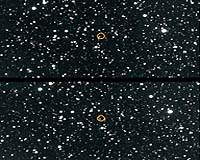
Paris, France (ESA) Mar 21, 2007 During the very first observations of Rosetta's flyby target 2867-Steins in March 2006 the onboard camera OSIRIS obtained the most accurate 'light curve' of this asteroid so far. OSIRIS observed Steins from a distance of 159 million kilometres and, from there, it obtained images and important clues about its characteristics. Although ESA's Rosetta is still far away from its destination comet 67P/Churyumov-Gerasimenko and its flyby targets 2867-Steins and 21-Lutetia, scientists have already started to collect preliminary data about these two largely unexplored asteroids. Advanced knowledge of the asteroids' properties (like size and rotation period) is essential for the preparation of the planned asteroid observation campaigns in September 2008 and July 2010, respectively. "Lutetia was imaged by Rosetta on 2 and 3 January 2007, whereas Steins was already observed during a 24-hour observation campaign on 11 March 2006. Both observations were aimed at pre-characterizing the rotation direction of the asteroid. "This can be done by the study of the so-called 'light curve' of the asteroid from different locations - by analysing how the light emitted by the observed object changes intensity for different observers, one can deduce in what direction the object rotates" explains Michael Kuppers from the Max-Planck-Institute for Solar System Research. The Optical, Spectroscopic, and Infrared Remote Imaging System (OSIRIS) on board Rosetta is up to this ambitious task. On its interplanetary cruise it provided an observing geometry of Steins that cannot be obtained from Earth. Although the brightness of the Steins asteroid during the measurement period was comparable to that of a candle seen at a distance of ~2000 kilometres, OSIRIS was able to measure brightness variations of the asteroid with an accuracy of better than two percent of its total brightness. The observations show that Steins rotates with a spin period of slightly more than six hours, in agreement with previous earth-based observations. The asymmetry of the light curve suggests an irregular shape of Steins. However, OSIRIS found no evidence for a 'tumbling' motion of the asteroid or the presence of a satellite. Work is ongoing to construct the orientation of the spin axis of Steins from a combination of the OSIRIS observations with ground-based data. Basically, asteroids are elemental components of the solar system, orbiting the sun for thousand of millions of years. For scientists, these minor bodies of rock or stone are much more than only boulders. Asteroids as well as comets carry important information about the origin of the Solar System - a better understanding of which is one of the primary goals of Rosetta. Rosetta will gather valuable data as it flies by these primordial rocks. Rosetta's instruments will provide information on the mass and density of the asteroids, thus telling us more about their composition, and will also measure their subsurface temperature and look for gas and dust around them. Asteroid 2867-Steins will be visited again by Rosetta on 5 September 2008 from a distance of just over 1700 kilometres. This encounter will take place at a relatively low speed of about 9 kilometres per second during Rosetta's first excursion into the asteroid belt. On 10 July 2010 Rosetta will pay its second visit to asteroid 21-Lutetia, passing within about 3000 kilometres of it, at a speed of about 15 kilometres per second. This article is based on the paper "Determination of the light curve of the Rosetta target asteroid (2867) Steins by the OSIRIS cameras onboard Rosetta," by M. Kuppers et al published in: Astronomy and Astrophysics, Vol. 462-1 (January IV 2007, A and A 462, p. L13). Email This Article
Related Links  Greenbelt MD (SPX) Mar 11, 2007
A menacing lump of rock and dust in space called 10195 (1999 RQ36) would barely be noticed except for two crucial facts: First, "It's a treasure trove of organic material, so it holds clues to how Earth formed and life got started," said Joseph Nuth of NASA's Goddard Space Flight Center, Greenbelt, Md. Second, it regularly crosses Earth's orbit, so it might impact us someday. |
|
|

| The content herein, unless otherwise known to be public domain, are Copyright 1995-2006 - SpaceDaily.AFP and UPI Wire Stories are copyright Agence France-Presse and United Press International. ESA PortalReports are copyright European Space Agency. All NASA sourced material is public domain. Additionalcopyrights may apply in whole or part to other bona fide parties. Advertising does not imply endorsement,agreement or approval of any opinions, statements or information provided by SpaceDaily on any Web page published or hosted by SpaceDaily. Privacy Statement |