|
 |
 |
 |
 |
 |
 |
 |
 |
 |

| . |  |
. |
Origin Of Life Under The Spotlight In Atlanta
Atlanta - Apr 5, 2002 The evidence is tattered, incomplete, unclear, ancient and sometimes open to conflicting explanations. It includes fossils 3.5 billion years old; the genomes of creatures great and small; biochemical clues to metabolism, cellular structure and genetic copying mechanisms; records of the planet's atmosphere; the laws of physics and the chemical fuel of life: sugars. But from these clues, experimental scientists from around the world are piecing together one of the most fascinating and difficult scientific questions of all time: how did life originate? For two days, April 19 and 20, some of the top researchers in this field will assemble at the Georgia Institute of Technology's Institute of Bioengineering and Bioscience (IBB) to discuss their latest findings with a broad-based group of Atlanta residents. The event is the 10th annual Suddath Symposium, named in memory of Georgia Tech biochemist Bud Suddath. "We are interested in not only where did we come from, but also whether we are alone in the universe," said Nicholas Hud, the symposium's organizer and an assistant professor of chemistry and biochemistry. "We'd like to know how it all came together and how hard it would be for it to happen again or in another place. If it's very difficult for life to begin, then the probability of it happening again or somewhere else may be quite low." The symposium's presentations work backward in time, beginning with the genomic and fossil records and concluding with discussions of metabolism and the role of sugar in powering life.
Topics and speakers include:
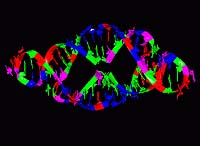
A biophysical chemist who studies the assembly of nucleic acid structures, Hud will contribute his own experimental work to the puzzle. Among the difficult questions facing scientists is how the complex RNA molecule � used by cells to read DNA, the blueprint of life � could have first been formed from the smaller and simpler molecules available on the prebiotic Earth. With collaborator Frank Anet, Hud has proposed a "molecular midwife" theory, suggesting a particular molecule spontaneously formed which had a size and shape that allowed it to serve as a template for organizing the bases of RNA: G, C, U and A. The first molecular replication process of life could have been powered by normal daily cycles on Earth. For example, the precursors for RNA could have existed in shallow pools of water or wet surfaces that dried each day in the heat of the sun. The act of drying could have advanced their assembly and replication, with the help of template molecules. During the night, the molecules could have been wet with rain or dew, re-hydrating and putting them back into solution to facilitate key biochemical reactions. Could many, many of these cycles over a long period of time have formed the structures essential for RNA? Hud's work on the small molecules that interact with DNA and RNA today suggest such a possibility. "In my laboratory, we have had some recent successes in which we can show that some small molecules imitate the shapes of the RNA bases when they are paired together, and that these have a great effect on the stability of RNA structures that contain these base pairs," he added. "This does support our theories that some small molecules that are not bonded to RNA or DNA could have been involved in their replication or assembly." Questions about the origin of life have long fascinated scientists, but recent advances in the tools for reading the genome have opened new opportunities for study. Hud argues that "origin of life" studies are undergoing something of a renaissance. "As scientists, we have to look at the data," he said. "When you look at the data, you can get an idea about the origin of life. At the symposium, I hope people will see that the origin of life research is truly an area of valid scientific research." Evolution study has created controversy in school systems in various locations around the United States. Hud acknowledges that evolution attracts scrutiny, but points out that many people don't see a conflict between science and the story of Creation as told in the Book of Genesis. "There are many people in society who have no problem accepting both evolution and a divine Creator," he said. "In their minds, God did it and this is how God did it. I think that's quite a healthy attitude. But everyone is entitled to his or her own opinion and free to believe whatever they want." Related Links Chemistry at Georgia Institute of Technology SpaceDaily Search SpaceDaily Subscribe To SpaceDaily Express  Meteorites Tell Of Shocking Experience In Planetary Formation
 Washington - Mar 27, 2002
The search for Earths around other stars is one of the most pressing questions in astrophysics today. To home in on what conditions are necessary for Earth-like bodies to form, however, scientists must first solve the mystery of how our own Earth arose. |
|
|

| The content herein, unless otherwise known to be public domain, are Copyright 1995-2006 - SpaceDaily.AFP and UPI Wire Stories are copyright Agence France-Presse and United Press International. ESA PortalReports are copyright European Space Agency. All NASA sourced material is public domain. Additionalcopyrights may apply in whole or part to other bona fide parties. Advertising does not imply endorsement,agreement or approval of any opinions, statements or information provided by SpaceDaily on any Web page published or hosted by SpaceDaily. Privacy Statement |