|
 |
 |
 |
 |
 |
 |
 |
 |
 |

| . |  |
. |
Peaks of Eternal Light Point To Lunar Ice Sites
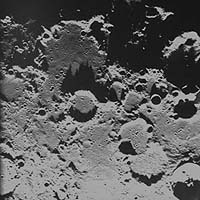
by Bernard Foing While the Earth is tilted at an angle of about 23 degrees, the moon's tilt is just over 1 degree. Because of this, the summits of some lunar crater rims are sunlit over very long periods. In some locations, there are "peaks of eternal light," or pics de lumiere eternelle, as the French astronomer Camille Flammarion called them at the end of the nineteenth century. NASA's Clementine spacecraft orbited the moon for three months in 1994. It identified some spots in the north polar region that are illuminated all the time during the summer, and others that are illuminated 80 percent of the time. This was not a big surprise, because we know that on Earth the poles receive a lot of sunlight during the summer. A question that the European Space Agency wanted to answer with the SMART-1 mission was whether there is enough solar light to still illuminate these places in winter. SMART-1 mapped the polar areas on the moon, and we recently found an illuminated site about 15 kilometers from the north pole. Even though most of the moon is dark in that region, there's a crater wall tall enough for sunlight to strike its rim. Such perpetually lit areas would be good places to start our exploration of the moon. If you didn't want to rely on complex power systems, you could install solar power stations at the peaks and use the energy to run small rovers and landers. Such systems are easier to design than electrical and mechanical systems that must withstand the extreme variation of temperature between lunar day and night. Branching out from there, you could build a spider web of facilities and habitats, with the core feeding energy to surrounding areas. A peak of eternal light would be a good place to retreat to in winter, where we could maintain low level operations. In the spring and summer, we could reach out to other parts of the moon, extending hundreds of kilometers from the core. The peaks provide some temperature stability. On the moon's equator, the temperature can vary from minus 170 degrees C to plus 110 degrees C. The peaks have less variation, and an average temperature of minus 30 degrees C. A solar collector placed on a peak could provide enough energy to maintain a habitat with a very comfortable temperature of 20 degrees C. With such a stable environment, you could do life science experiments to test how life adapts on another world. We could see how bacteria withstand the radiation environment. We could develop plant growth experiments in preparation for human bases. But we also want to know if different organisms can survive and proliferate in the extreme conditions of the moon. By experimenting with different temperatures, artificial pressure, and other factors, we could figure out whether we even needed to develop lunar greenhouses. Do we need to recreate an exact copy of Earth conditions, or can we just adapt aspects of lunar conditions and make use of local resources? Some astronomers are interested in the peaks of eternal light. You could build a very large observatory, at some distance from a peak of eternal light, that could observe the universe unattended. Because there's no atmosphere on the moon, sunlight does not get scattered, so you can make observations even during part of the daytime. Finally, just as the moon's axis of rotation produces peaks of eternal light, there are also places, like the bottoms of some craters near the poles, that are in permanent shadow. We are very interested in such craters because they may contain water ice. That could be a valuable resource for future bases on the moon. So a peak of eternal light would be a good central base from which to begin our lunar activities. It could provide a source of solar power for exploration, astronomical observations, life science experiments, and the investigation of possible water in the dark craters. To extend beyond a few hundred kilometers from the peaks, however, we would need to develop nuclear power systems. That would provide enough energy to allow us to grow from a little refuge to a global village on the moon. Related Links SpaceDaily Search SpaceDaily Subscribe To SpaceDaily Express  Tulips On The Moon
 Moffet Field CA (SPX) Jun 28, 2005
Bernard Foing, Chief Scientist at the European Space Agency, is also Project Scientist for SMART-1, a spacecraft now orbiting the Moon. SMART-1 is currently mapping the lunar surface topography and mineralogy, and scientists hope this information will lead to new insights about the Moon's evolution. |
|
|

| The content herein, unless otherwise known to be public domain, are Copyright 1995-2006 - SpaceDaily.AFP and UPI Wire Stories are copyright Agence France-Presse and United Press International. ESA PortalReports are copyright European Space Agency. All NASA sourced material is public domain. Additionalcopyrights may apply in whole or part to other bona fide parties. Advertising does not imply endorsement,agreement or approval of any opinions, statements or information provided by SpaceDaily on any Web page published or hosted by SpaceDaily. Privacy Statement |