|
 |
 |
 |
 |
 |
 |
 |
 |
 |

| . |  |
. |
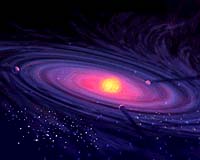
Planetary Crunch Took 20 Million Years
New Brunswick � Mar 12, 2002 Researchers using refined techniques to study minerals from meteorites now believe it took about 20 million years for the Earth to coalesce from the materials already gathered around our sun as the solar system. Recent estimates had pegged the interval closer to 50 million years. Brigitte Zanda-Hewins, an adjunct member of the graduate faculty at Rutgers department of geological sciences and associate professor at the mineralogy laboratory of the Mus�um National d'Histoire Naturelle in Paris, is among a group of researchers publishing its findings in the international journal Science, on Mar. 1. The group studied radioactive forms of the elements niobium and zirconium found in samples of meteorites. Because meteorites are the oldest objects of our solar system available for study, scientists use their components as a kind of "radioactive chronometer" to help estimate time intervals separating events during the formation of the solar system, including the formation of the Earth. While recent attempts to use the niobium-zirconium "chronometer" had produced the 50-million-year estimate, Zanda-Hewins said the new 20-million-year figure is the result of performing mineral separations in the samples for the first time, and using extreme precautions to maintain the purity of the samples. Researchers used special processing equipment, anti-contamination air flow and filters, magnetic separation devices and a wide range of chemical separation techniques to avoid any interference by foreign materials. "We designed an extremely careful approach to separate the minerals and isolate the right ones," she said. The method is described in the article entitled "Niobium-Zirconium Chronometry and Early Solar System Development." Zanda-Hewins' co-authors are Maria Sch�nb�chler, Mark Rehk�mper, Alex N. Halliday and Der-Chuen Lee of ETH Zurich Institute of Isotope Geology and Mineral Resources; Bodo Hattendorf and Detlef G�nther of ETH Zurich Laboratory of Inorganic Chemistry; and Mich�le Bourot-Denise of the Mus�um National d'Histoire Naturelle in Paris. Besides her work at Rutgers, Zanda-Hewins is well-known as a Paris-based geologist who helps coordinate distribution of meteorite samples for scientific study around the world. She is the author of the 2001 book "Meteorites: Their Impact on Science and History." Related Links Rutgers, the State University of New Jersey SpaceDaily Search SpaceDaily Subscribe To SpaceDaily Express  When Did Liquid Water Fill The Planets
 Paris (ESA) Jan 21, 2002
Planet-like bodies with liquid water formed very early in the history of the Solar System, or so scientists used to think. That scenario may now be due for revision after a finding with ESA's Infrared Space Observatory, ISO. |
|
|

| The content herein, unless otherwise known to be public domain, are Copyright 1995-2006 - SpaceDaily.AFP and UPI Wire Stories are copyright Agence France-Presse and United Press International. ESA PortalReports are copyright European Space Agency. All NASA sourced material is public domain. Additionalcopyrights may apply in whole or part to other bona fide parties. Advertising does not imply endorsement,agreement or approval of any opinions, statements or information provided by SpaceDaily on any Web page published or hosted by SpaceDaily. Privacy Statement |