|
 |
 |
 |
 |
 |
 |
 |
 |
 |

| . |  |
. |
Plutonium: Size Does Matter
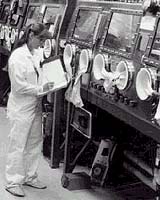
Los Alamos - Oct 21, 2002 Los Alamos National Laboratory researchers have found a better way to measure plutonium oxide particles in glove boxes where plutonium research is done. The new system will help improve the quality and safety of several key plutonium processes. Los Alamos technician Carl D. Martinez of PIT Disposition Science and Technology group (NMT-15) presented last week, findings on improved glove-box measurements of plutonium oxide particle size at the Rocky Mountain Regional meeting of the American Chemical Society in Albuquerque. Martinez's work focuses on the implementation and use of a new Beckman Coulter Counter particle measurement instrument. The Coulter unit is one of three instruments that will be used to gather particle data with a third instrument being installed in November. The project is part of a quality assurance initiative in place at NMT-15. Using off the shelf instrumentation such as the Coulter Counter, Lab researchers are working to improve the methods and quality of the data gathered. With just two of the three instruments up and running the researchers have begun to take data and have begun the process of comparing the data and evaluating the instruments. Once all three instruments are online, data from all the instruments will be taken and compared to one another as well as against existing standards. "This in turn will help us create a baseline for developing a systematic approach for measuring Plutonium oxide and how process changes affect particle size," said Donna Smith, technical staff member with NMT-15. In addition to providing valuable data, the new quality improvement initiative will also help to ensure that production is meeting program specifications and that methods and processes employed remain safe, with the majority of measurable plutonium particle size above 5 micrometers. "The data and information that we have gotten so far has been invaluable and will help us as we continue forward with our plan" Martinez said. "It will be very helpful in ensuring the quality and safety of our oxide operations". Related Links Los Alamos National Laboratory SpaceDaily Search SpaceDaily Subscribe To SpaceDaily Express  AeroAstro To Supply Star Tracker and Integrated Avionics For Test Sat
 Ashburn - Oct 21, 2002
AeroAstro was recently awarded two Department of Defense Small Business Technology Transfer (STTR) contracts. Under contract through the Air Force Research Laboratory (Air Force Materiel Command), and in partnership with the University of Alabama in Huntsville (UAH), AeroAstro will develop an integrated avionics module for short-duration missions. |
|
|

| The content herein, unless otherwise known to be public domain, are Copyright 1995-2006 - SpaceDaily.AFP and UPI Wire Stories are copyright Agence France-Presse and United Press International. ESA PortalReports are copyright European Space Agency. All NASA sourced material is public domain. Additionalcopyrights may apply in whole or part to other bona fide parties. Advertising does not imply endorsement,agreement or approval of any opinions, statements or information provided by SpaceDaily on any Web page published or hosted by SpaceDaily. Privacy Statement |