|
 |
 |
 |
 |
 |
 |
 |
 |
 |

| . |  |
. |
Pressable Photonic Crystals Produce Full-Colour Fingerprints
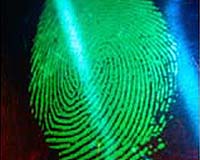
Toronto ON (SPX) Mar 15, 2006 In the future, law enforcement officials may take full-colour fingerprints using new technology developed by a University of Toronto-led team of international researchers. Far from the basic black-and-white fingerprints collected today, the new technology would use elastic photonic crystals to capture data-rich fingerprints in multiple colours, but the fingerprinting technique is just one potential application for the new technology. A paper on the new research is featured on the cover of the current issue of the journal Nature Materials. "You can elastically deform these crystals and produce different colours," says lead author Andre Arsenault, a PhD candidate in the laboratory of Geoffrey Ozin, a University Professor in the Department of Chemistry and a Canada Research Chair in materials chemistry. Photonic crystals are a relatively new development in the scientific quest to control light. Ozin's lab first created photonic crystals in 2002, using spherical particles of silica mere micrometres in diameter that self-assemble into neat layers, creating what's known as an opal. After filling the space between the spheres with silicon, they used acid etching to remove the silica balls. This left an ordered sponge of air bubbles in silicon known as an inverse opal. This photonic crystal material, the first of its kind, did indeed trap light. These photonic crystals can produce colour based on how an electromagnetic wave interacts with the structure -- meaning that it could be tuned to produce any colour. In the new study, the team injected an elastic compound between the spheres, which were then etched away, leaving an orderly and compressible elastic foam that can be transferred onto virtually any surface, such as glass, metal or plastic. The material changes colour based on how far the spheres are separated. "The material we have is very, very thin," Arsenault says. "We can coat it onto any surface we want." If the foam is compressed, it alters the lattice dimensions, changing the wavelength of light that it produces. The team demonstrated the fingerprint application, using Arsenault's finger, and produced both still images and a video of the process, which captures detailed information about pressure patterns and surface ridges that may not be visible to the naked eye. Taking it one step further, Arsenault made a rubber replica of his fingertip, which might fool a traditional fingerprint scan. "If you press the rubber replica into the material, the pressure impressions that you get are very different," he says. "The lines are much sharper, because the material is less soft. From the standpoint of biometrics, this could provide better security." Arsenault says the technology could be used not only for colour fingerprints, but in sensors for air-bag release mechanisms in cars, strain and torque sensors on support beams of high-rise buildings and in laser sources. The study was funded by the Natural Sciences and Engineering Research Council of Canada, the University of Toronto, EC NoE Phoremost and Deutsche Forschungsgemeinschaft. Related Links University of Toronto  Biometric Data Keeps Captured Terrorists Behind Bars
 Washington DC (SPX) Mar 15, 2006
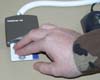
A high-tech Defense Department identification system has linked some captured terrorists to previous crimes and prevented their release from overseas detention facilities, senior defense officials said at a Senate Armed Services Committee hearing here March 10. |
|
|

| The content herein, unless otherwise known to be public domain, are Copyright 1995-2006 - SpaceDaily.AFP and UPI Wire Stories are copyright Agence France-Presse and United Press International. ESA PortalReports are copyright European Space Agency. All NASA sourced material is public domain. Additionalcopyrights may apply in whole or part to other bona fide parties. Advertising does not imply endorsement,agreement or approval of any opinions, statements or information provided by SpaceDaily on any Web page published or hosted by SpaceDaily. Privacy Statement |