 |
 |
 |
 |
 |
 |
 |
 |
 |
 |

| . |  |
. |
Prime Time For Rhea
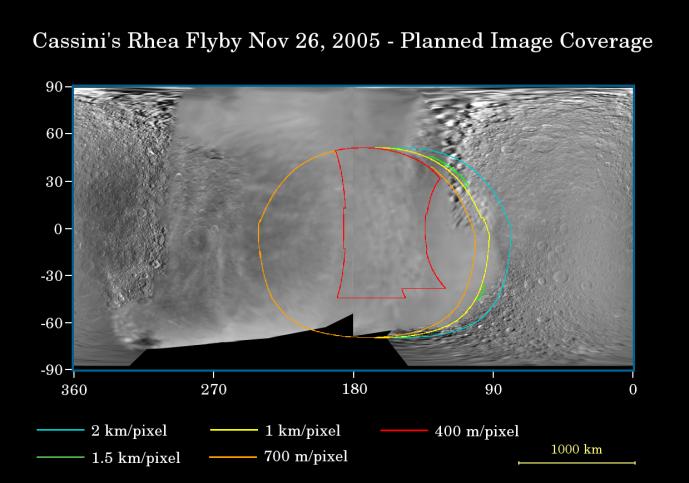
Pasadena CA (JPL) Nov 18, 2005 This map of the surface of Saturn's moon, Rhea, illustrates the regions that will be imaged by Cassini during the spacecraft's close flyby of the moon on Nov. 26, 2005. At closest approach, the spacecraft is expected to pass approximately 500 kilometers (310 miles) above the moon's surface. The colored lines delineate the regions that will be imaged at differing resolutions, listed in the legend at bottom. Rhea is 1,528 kilometers (949 miles) across. The new high-resolution coverage will examine details on the anti-Saturn hemisphere of Rhea, including two large impact basins there. Cassini previously imaged terrain farther to the south of this at approximately 1 kilometer (0.6 mile) per pixel in August 2005 (see PIA07566). Imaging scientists also hope to get a high-resolution view of a relatively young 50-kilometer-wide (30-mile) crater on the moon's leading hemisphere (see PIA06648). Planetary scientists are interested in learning about the compositional makeup of Rhea, other than water ice, as well as the nature of the wispy streaks on the moon's trailing hemisphere. In December, 2004, Cassini revealed that similar bright, wispy markings on Dione are actually a system of braided tectonic fractures (see PIA06162). The map was made from images obtained by both the Cassini and NASA Voyager spacecraft. Related Links SpaceDaily Search SpaceDaily Subscribe To SpaceDaily Express  Cassini Unveils Colorful Cratered Calypso
 Pasadena CA (JPL) Nov 18, 2005
This color image provides the best look yet at Saturn's moon Calypso, a Trojan (trailing moon) of the larger moon Tethys. Calypso trails Tethys in its orbit by 60 degrees. |
|
|

| The content herein, unless otherwise known to be public domain, are Copyright 1995-2006 - SpaceDaily.AFP and UPI Wire Stories are copyright Agence France-Presse and United Press International. ESA PortalReports are copyright European Space Agency. All NASA sourced material is public domain. Additionalcopyrights may apply in whole or part to other bona fide parties. Advertising does not imply endorsement,agreement or approval of any opinions, statements or information provided by SpaceDaily on any Web page published or hosted by SpaceDaily. Privacy Statement |