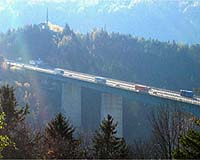
The Brenner autobahn - chief highway through the Alps
The Brenner autobahn - chief highway through the Alps |
The growing level of goods traffic is recognised as one of the greatest challenges facing alpine countries. The rapidly increasing number of freight traffic on the alpine transit routes impacts the environment and increases the risks to residents' health. A cross-national approach, in which the individual alpine regions in particular must be involved, is necessary to ease the problem.
ALPNAP supports the responsible authorities in the planning and implementation of impact reduction measures, for example dynamic speed limits such as those recently introduced in the Tirol. The ALPNAP Report, a handbook for the responsible planning authorities, for the first time describes the most effective scientific methods for recording and forecasting air pollution and noise including the negative impacts on the quality of life of the population. It details in particular the complicated conditions for the spread of pollutants and noise in the alpine valleys and includes recommended courses of action.
In the project, part of the DLR traffic programme, the Institute of Atmospheric Physics applied various processes to forecast traffic noise. In addition, the scientists also carried out combined analyses concerning the degree to which noise and the concentration of air pollutants in Unterinn Valley is dependent on the weather.
It emerged that noise protection walls alongside autobahns in valleys only protect cliff-side residents to a limited degree and therefore the construction of such walls must be thoroughly checked. It was also demonstrated that certain weather conditions in the valleys amplify the impact of noise and pollution and cause limit values to be exceeded. Using these findings as a base, traffic management measures can now be undertaken according to the respective weather conditions, and peaks in pollution can be prevented
European network
ALPNAP is a project that is partially financed by funds from the European Fund for Regional Development and is in the INTERREG IIIB Alpine Region Programme. It has been running since January 2005 and unites eleven partners from four countries.
Experts from universities and research centres in Germany, Austria, Italy and France are forming a pan-Alp network in the areas of mountain meteorology, air pollution, noise and health ramifications. As part of this, ALPNAP communicates with the project MONITRAF which records and studies the impact of the inner alpine and cross-alpine road traffic along the four transit corridors of Brenner, Frejus, Gotthard and Mont Blanc .
The goal is to develop joint measures to minimise the negative impacts of road traffic and to improve the quality of life in the alpine region. In doing so, measures taken for one transport axis must not result in additional strain on another. The outcomes of ALPNAP's project, which are also summarised in a brochure, now provide the necessary knowledge to prevent this.
Community
 EU threatens Italy with court action over rubbish crisis
 Brussels (AFP) Jan 29, 2008
| The content herein, unless otherwise known to be public domain, are Copyright 1995-2007 - SpaceDaily.AFP and UPI Wire Stories are copyright Agence France-Presse and United Press International. ESA Portal Reports are copyright European Space Agency. All NASA sourced material is public domain. Additional copyrights may apply in whole or part to other bona fide parties. Advertising does not imply endorsement,agreement or approval of any opinions, statements or information provided by SpaceDaily on any Web page published or hosted by SpaceDaily. Privacy Statement |