|
 |
 |
 |
 |
 |
 |
 |
 |
 |

| . |  |
. |
Russia And India Sign Joint Lunar Research Deal
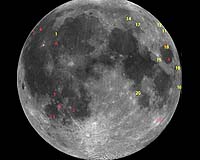
Moscow (RIA Novosti) Nov 13, 2007 Russia's Federal Space Agency (Roskosmos) and the Indian Department of Space have signed a joint lunar research and exploration agreement, the Russian agency said on Monday. The agreement was signed by Roskosmos chief Anatoly Perminov and Madhavan Nair, secretary of India's Department of Space and chairman of the Space Commission. Indian Prime Minister Manmohan Singh is currently on an official visit to Moscow. Georgy Polishchuk, general director of Russia's Lavochkin design bureau, said Russia would launch an unmanned mission to the Moon, Luna-Glob, in 2010. The second mission, which will include putting a new-generation 400-kg Lunokhod unmanned rover on the Moon, will start in 2011. "The first mission will be solely Russian, but the second will be carried out in conjunction with India," Polishchuk said. He said India will provide a rocket and a flight module for the mission, which will be launched from an Indian space center. The third and fourth stages (2012-2015) will include the study of mineral resources and other scientific and research experiments on the Moon. Russia, a pioneer in robotic lunar research, abandoned its lunar exploration program with the end of the Moon race in the mid-1970s, but the idea of exploring the Earth's natural satellite has been revisited recently, due to ambitious international projects to develop the Moon's resources and to use it as a stepping-stone for further space exploration. Roskosmos said earlier its first unmanned flight will include a lunar orbiter that will fire 12 penetrators across diverse regions of the Moon to create a seismic network, which will be used to study the Moon's origin. After firing the penetrators, the mother ship will deliver a polar station, equipped with a mass spectrometer and neutron spectrometer, to the surface. The objective of the station is to detect water ice deposits in the polar zones of the Moon. The device, developed by Russian scientists, will first be tested through NASA's Lunar Reconnaissance Orbiter project, to be launched in 2008. In the 1950s-1970s, the Soviet Union carried out 60 robotic lunar missions, of which about 20 were partially or fully successful.
Source: RIA Novosti Community Email This Article Comment On This Article Related Links Mars News and Information at MarsDaily.com Lunar Dreams and more
 Japan Set To Bring The Moon To Your Wall TV
 Tokyo, Japan (SPX) Nov 09, 2007
The Japan Aerospace Exploration Agency (JAXA) and NHK (Japan Broadcasting Corporation) have successfully performed the world's first high-definition image taking by the lunar explorer "KAGUYA" (SELENE,) which was injected into a lunar orbit at an altitude of about 100 km on October 18, 2007, (Japan Standard Time. Following times and dates are all JST.) |
|
|

| The content herein, unless otherwise known to be public domain, are Copyright 1995-2007 - SpaceDaily.AFP and UPI Wire Stories are copyright Agence France-Presse and United Press International. ESA Portal Reports are copyright European Space Agency. All NASA sourced material is public domain. Additional copyrights may apply in whole or part to other bona fide parties. Advertising does not imply endorsement,agreement or approval of any opinions, statements or information provided by SpaceDaily on any Web page published or hosted by SpaceDaily. Privacy Statement |