|
 |
 |
 |
 |
 |
 |
 |
 |
 |

| . |  |
. |
SMART 1 Uses New Imaging Technique In Lunar Orbit
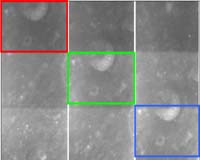
Paris, France (ESA) Dec 28, 2005 ESA's SMART-1 spacecraft has been surveying the Moon's surface in visible and near-infrared light using a new technique, never before tried in lunar orbit. For the last few months, the Advanced Moon Imaging Experiment (AMIE) on board SMART-1, has been opening new ground by attempting multi-spectral imaging in the "push-broom" mode. This technique is particularly suited to colour imaging of the lunar surface. (Note that "colour imaging" here does not mean natural colour, the colour bands of the AMIE filters are in the infrared region and are selected such that the intensity of the iron absorption line can be determined from brightness ratios of the images.) In this mode, AMIE takes images along a line on the Moon's surface perpendicular to the ground track of the spacecraft. It relies on the orbital motion of the spacecraft to reposition it as it records a sequence of images known as an "image swath". The AMIE camera on board SMART-1 has fixed-mounted filters which see the Moon in different colour bands. The figure shows four consecutive images taken by AMIE from left to right. The fixed filters are indicated by coloured frames. The images, taken only a few seconds apart, show how the surface is moving through the different filters. The spacecraft is moving over the Moon's surface at a speed of more than a kilometre per second! By combining images showing the same feature on the Moon as seen through different filters, colour information can be obtained. This allows to study the mineralogical composition on the lunar surface, which in turn lets scientists deduce details of the formation of our celestial companion. Whereas the multi-spectral camera aboard the US Clementine mission had constant illumination conditions, SMART-1's orbit will offer different viewing angles. AMIE's views correlated with Clementine data of the same lunar areas will allow scientists to better interpret such spectral data. Related Links Advanced Moon micro-Imager Experiment (AMIE) SpaceDaily Search SpaceDaily Subscribe To SpaceDaily Express  An Explosion On The Moon
 Huntsville AL (SPX) Dec 28, 2005
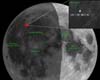
December 23, 2005: NASA scientists have observed an explosion on the moon. The blast, equal in energy to about 70 kg of TNT, occurred near the edge of Mare Imbrium (the Sea of Rains) on Nov. 7, 2005, when a 12-centimeter-wide meteoroid slammed into the ground traveling 27 km/s. |
|
|

| The content herein, unless otherwise known to be public domain, are Copyright 1995-2006 - SpaceDaily.AFP and UPI Wire Stories are copyright Agence France-Presse and United Press International. ESA PortalReports are copyright European Space Agency. All NASA sourced material is public domain. Additionalcopyrights may apply in whole or part to other bona fide parties. Advertising does not imply endorsement,agreement or approval of any opinions, statements or information provided by SpaceDaily on any Web page published or hosted by SpaceDaily. Privacy Statement |