|
 |
 |
 |
 |
 |
 |
 |
 |
 |

| . |  |
. |
Scientists Develop World's Longest Electrically Conducting Nanotubes
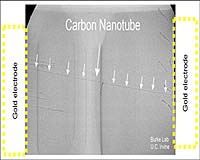
Irvine CA (SPX) Oct 19, 2004 UC Irvine Monday announced that scientists at The Henry Samueli School of Engineering have synthesized the world's longest electrically conducting nanotubes. These 0.4 cm nanotubes are 10 times longer than previously created electrically conducting nanotubes. The breakthrough discovery may lead to the development of extremely strong, lightweight materials and ultradense nano-memory arrays for extremely powerful computers, ultralow-loss power transmission lines, and nano-biosensors for use in health care applications. A nanotube is commonly made from carbon and consists of a graphite sheet seamlessly wrapped into a cylinder only a few nanometers wide. A nanometer is one billionth of a meter, about the size of 10 atoms strung together. Peter Burke, assistant professor of electrical engineering and computer science, conducted the research along with graduate students Shengdong Li, Christopher Rutherglen and Zhen Yu. "We are extremely excited about this discovery," said Burke. "Recently there have been several key advances around the world in synthesizing very long carbon nanotubes. Our research has taken a significant step forward by showing we can pass electricity through these long nanotubes." "Significantly, we have found that our nanotubes have electrical properties superior to copper. This clearly shows for the first time that long nanotubes have outstanding electrical properties, just like short ones." Researchers grew the carbon nanotubes using a simple procedure: Burke allowed natural gas to react chemically with tiny iron particles or "nanoparticles" inside a small furnace. By placing a small amount of gold under the iron, Burke's group found that ultralong nanotubes grow; whereas without the gold, only short nanotubes grow. Because nanotubes are so small, it is difficult to connect regular wires to them. Using gold in the growth process, Burke solved this problem by growing nanotubes that come out already attached to gold wires. An added scientific benefit is that Burke was able to accurately determine how the electrical resistance of a nanotube depends on its length. The relationship between resistance and physical size (length) is a key property of any new material. Burke's finding indicates that the electrical conductivity is greater than for copper wires of the same size, a world record for any nano-material of this length. The findings are reported in the September issue of Nano Letters, a peer-reviewed journal of the American Chemical Society, the world's largest scientific society. The Army Research Office, the Office of Naval Research, the Defense Advanced Research Projects Agency, and the National Science Foundation provided funding for the research, which took place at UCI's Integrated Nanosystems Research Facility in The Henry Samueli School of Engineering. Related Links The Henry Samueli School of Engineering SpaceDaily Search SpaceDaily Subscribe To SpaceDaily Express  A Nanowire With A Surprise
 Upton NY (SPX) Oct 19, 2004
Scientists at the U.S. Department of Energy's Brookhaven National Laboratory and their collaborators have discovered that a short, organic chain molecule with dimensions on the order of a nanometer (a billionth of a meter) conducts electrons in a surprising way: It regulates the electrons' speed erratically, without a predictable dependence on the length of the wire. This information may help scientists learn how to use nanowires to create components for a new class of tiny electronic circuits. |
|
|

| The content herein, unless otherwise known to be public domain, are Copyright 1995-2006 - SpaceDaily.AFP and UPI Wire Stories are copyright Agence France-Presse and United Press International. ESA PortalReports are copyright European Space Agency. All NASA sourced material is public domain. Additionalcopyrights may apply in whole or part to other bona fide parties. Advertising does not imply endorsement,agreement or approval of any opinions, statements or information provided by SpaceDaily on any Web page published or hosted by SpaceDaily. Privacy Statement |