|
 |
 |
 |
 |
 |
 |
 |
 |
 |

| . |  |
. |
Seafloor Creatures Destroyed By Ice Action During Ice Ages
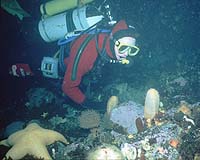
Southampton, UK (SPX) Oct 19, 2005 The ice ages made massive changes to the Earth's landscape. But what was happening below the ice in the oceans? Research by marine scientists reveals that it was a time of mass destruction as whole communities of animals were wiped out by ice sheets scouring the sea floor. In the past it has been thought that these ecosystems somehow dodged extinction by recolonising from nearby habitats that escaped obliteration. But researchers at the National Oceanography Centre, Southampton (NOC) and the British Antarctic Survey (BAS) reveal a bleaker scenario. Dr Sven Thatje, an ecologist at NOC has been working with geoscientists, Dr Claus-Dieter Hillenbrand and Dr Rob Larter at BAS examining one of the harshest environments on Earth - the Antarctic seafloor. Writing in the October issue of Trends in Ecology & Evolution the scientists provide new evidence that suggests that seafloor organisms were either erased by the advance of ice sheets across the Antarctic continental shelf or starved to death as links in the food chain were broken by the permanent ice cover. There would have been no refuge for shallower living animals further down the continental slope, as huge sediment slides would have buried them. Typically these ecosystems would have been made up of sponges, urchins, sea fan corals, and starfish. Dr Thatje said: 'We show that during ice ages seafloor organisms emigrated to the deep sea - below the effects of the sediment slides and ice. From there, organisms may have invaded open marine shelters of the Antarctic shelf, which were not affected by the advance of ice masses. Or these animals may have recolonised the Antarctic shelf from the deep-sea during the warm period following each ice age. 'Either way it is an impressive feat against the odds as the extreme cold means that these animals respond much more slowly to the destruction of their habitat than elsewhere in the oceans. They have lower metabolic rates that lower their growth and reproductive rates. Elsewhere in the oceans, a brisingid starfish would reproduce annually and live for ten years. In the Antarctic these starfish can reach 100-years-old but reproduce only once every ten years. This means that full community recuperation takes up to hundreds of years.' Dr Claus-Dieter Hillenbrand explained: 'Until now it was commonly thought that the destructive action of the ice sheets was not significant enough to eradicate all the fauna and that desolate patches were recolonised from surrounding areas. But our research confirms that the destruction was wholesale with very little surviving. Even today calving icebergs ploughing across the seafloor destroy everything in their path. Imagine the impact of ice sheets during the ice ages that covered a much wider area in a time of lower sea levels.' The team's research will lead to a radical rethink of the evolutionary history of Antarctica as the work challenges all the accepted theories. The scientists argue that shallow water animals were retreating to the deep ocean and then returning to recolonise Antartica's shelf seas. Clues to how these two very different communities could have achieved this may lie in the animals' DNA. Sven Thatje continued: 'Our work means that the text books will need to be rewritten. Our next task is to reconstruct what happened in Antarctica during these periods of climate change and study the genetic and biological links between deep sea and shallow water communities.'
Related Links The National Oceanography Centre, Southampton British Antarctic Survey SpaceDaily Search SpaceDaily Subscribe To SpaceDaily Express  Arctic Sea Ice Continues Decline As Temperatures Rise
 Seattle WA (SPX) Sep 29, 2005
For the fourth consecutive year, NSIDC and NASA scientists using satellite data have tracked a stunning reduction in arctic sea ice at the end of the northern summer. The persistence of near-record low extents leads the group to conclude that Arctic sea ice is likely on an accelerating, long-term decline. |
|
|

| The content herein, unless otherwise known to be public domain, are Copyright 1995-2006 - SpaceDaily.AFP and UPI Wire Stories are copyright Agence France-Presse and United Press International. ESA PortalReports are copyright European Space Agency. All NASA sourced material is public domain. Additionalcopyrights may apply in whole or part to other bona fide parties. Advertising does not imply endorsement,agreement or approval of any opinions, statements or information provided by SpaceDaily on any Web page published or hosted by SpaceDaily. Privacy Statement |