|
 |
 |
 |
 |
 |
 |
 |
 |
 |

| . |  |
. |
Solution To Clean Space Dust From Mars Exploration Vehicles
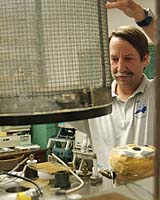
Boone NC (SPX) Sep 01, 2005 If keeping dust under control at your house is a challenge, imagine keeping clear the solar panels that power unmanned exploration vehicles on Mars. Sid Clements, a physics professor at Appalachian State University, is part of a 12-member team of scientists across the United States working on a NASA project to solve the problem. Clements's research at Appalachian focuses on both electrostatic applications and electrostatic hazards in the space program, including those in the Space Shuttle, International Space Station, and the exploration of the moon and Mars. Even before unmanned research vehicles landed on Mars, scientists knew that dust would become a problem, Clements said. "There's no solution so far," he explained. "The dust slowly accumulates on the solar panel to the point it can't generate enough power." Because the atmosphere on Mars is so thin and conditions are extremely dry, dust particles become charged, making them stick more readily to surfaces. "You can't just wipe charged dust off a surface with a brush," Clements said. "It's a big problem." Working with both undergraduate and graduate students in Appalachian's Department of Physics and Astronomy, Clements is designing and testing prototypes of an electromagnetic screen that might successfully remove dust from solar cell panels on Mars Exploration Rovers. The test screen looks like a small printed circuit board, minus the diodes and transistors. The screen has high-voltage, multiphase electrodes that produce a traveling electric field or "wave" which carries the charged dust particles off the surface. The next step in the research will be to test screens with transparent conductors made of indium tin oxide or carbon nanotubes that would not interfere with the solar panels' operation. Clements is testing screen designs in his campus lab simulating Martian conditions in a depressurized chamber, complete with simulated Mars dust made from volcanic material from Hawaii. What he and other scientists learn in the lab will also be applied to other applications. Lunar dust particles were a problem for Apollo astronauts on the moon. Dust from the surface accumulated on their space suits and worked its way into various mechanical joints. Thermal radiators used to dispel heat on the lunar roving vehicle had to be covered during sorties to prevent dust accumulation, which limited the LRV's range. Astronauts inadvertently carried dust into the lunar module where it affected air quality in the spacecraft. This is a health risk because lunar dust contains sharp particles that resemble silica or glass that can cause silicosis, a serious lung disease. Clements's work for the Kennedy Space Center's Electrostatics and Surface Physics Laboratory is expected to take two years to complete. The overall project is being coordinated by the University of Arkansas-Little Rock. Clements's research grant totals $86,870. Related Links Appalachian State University SpaceDaily Search SpaceDaily Subscribe To SpaceDaily Express  Recovering From A Reset
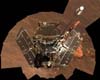 Pasadena CA (JPL) Aug 31, 2005
On sol 560 (Aug. 21, 2005), Opportunity retracted the Moessbauer spectrometer from a rock target called "Lemon Rind" that had been brushed earlier with the rock abrasion tool. |
|
|

| The content herein, unless otherwise known to be public domain, are Copyright 1995-2006 - SpaceDaily.AFP and UPI Wire Stories are copyright Agence France-Presse and United Press International. ESA PortalReports are copyright European Space Agency. All NASA sourced material is public domain. Additionalcopyrights may apply in whole or part to other bona fide parties. Advertising does not imply endorsement,agreement or approval of any opinions, statements or information provided by SpaceDaily on any Web page published or hosted by SpaceDaily. Privacy Statement |