 |
 |
 |
 |
 |
 |
 |
 |
 |
 |

| . |  |
. |
State-Of-The-Art Solar Model Fits Massive 2002 Eruption
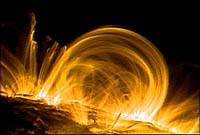
Boston - Jun 30, 2003 As computer power and speed continues to increase, scientists are developing ever more sophisticated computer models that can predict the weather, help design cars and planes, and even evaluate new medicines. Astronomers use models, too - in order to investigate how solar systems form, how stars are born, even how the Universe began. One particularly relevant subject for modeling is our nearest star, the Sun. The Sun pours out beneficial light and heat, but also dangerous energetic particles and radiation. Solar physicists Jun Lin (Harvard-Smithsonian Center for Astrophysics) and Terry G. Forbes (University of New Hampshire) have developed a state-of-the-art computer model for the massive solar eruptions that threaten satellites, communications networks and power grids. Their model matched observations by the Smithsonian Astrophysical Observatory's UltraViolet Coronagraph Spectrometer (UVCS) on the SOHO satellite, which observed a real-world blast from the Sun in April of 2002, providing hope that one day such models will predict solar eruptions and space weather. "By building on four decades of modeling work conducted by many researchers, we have developed a computer code to describe the entire development of a solar eruption from beginning to end. By improving our understanding of the physics behind these blasts, we hope to improve our ability to predict them," said Lin.
Earthly Effects Of Solar Eruptions If an airplane were able to travel that fast, a trip across the United States would take only 2 seconds, and a round-the-world flight would last 20 seconds. CMEs can eject up to 200 billion pounds of matter into interplanetary space. These bursts of plasma can wreak havoc if they impact the Earth. CMEs have the potential to disable satellites, disrupt pager and cell phone networks, and knock out electrical power grids. They also pose a danger to astronauts, particularly future travelers to Mars. "An astronaut on Mars, unprotected by a strong magnetic field and thick atmosphere like we have on Earth, could be exposed to a lethal dose of radiation and ionized particles. All of these reasons show why it is so important that we understand, and eventually be able to predict, CMEs," said Lin.
A Successful CME Model The Lin & Forbes model is the first to predict that a long current sheet is a key feature of CMEs. The current sheet is a region where oppositely directed magnetic fields annihilate one another, in a process known as magnetic reconnection, releasing magnetic energy to accelerate and heat the CME as it erupts from the Sun's surface and blasts outward through the solar corona. An April 21, 2002 eruption provided an excellent opportunity to gather data that could be compared to the Lin & Forbes model. A large suite of instruments on the SOHO, TRACE and RHESSI spacecraft all observed this eruption in exquisite detail. While TRACE and RHESSI observed the initiation of the eruption, the UVCS instrument on SOHO observed this event above the surface in the region of peak acceleration. Its observations provided direct evidence of the hot gas identified with the current sheet predicted by the Lin & Forbes model. This is the strongest evidence yet that the Lin & Forbes model is an accurate description of how CMEs are produced. UVCS also found that the shock wave did not form until the CME reached a larger height, and showed the rapid disruption of the corona as the hot magnetic bubble predicted by the Lin & Forbes model was accelerated upwards and pushed the coronal gas aside. Lin and his colleagues expect to continue improving and refining their CME computer model as more is learned about the physics behind these eruptions. Related Links Harvard-Smithsonian Center for Astrophysics SpaceDaily Search SpaceDaily Subscribe To SpaceDaily Express  SOHO shows first sign of aging
 Paris (ESA) Jun 25, 2003
The ESA/NASA SOHO spacecraft, launched in 1995, has been delivering outstanding data about the Sun for over eight years. Recently, however, an anomaly on the pointing mechanism of its high-gain antenna has been recorded. |
|
|

| The content herein, unless otherwise known to be public domain, are Copyright 1995-2006 - SpaceDaily.AFP and UPI Wire Stories are copyright Agence France-Presse and United Press International. ESA PortalReports are copyright European Space Agency. All NASA sourced material is public domain. Additionalcopyrights may apply in whole or part to other bona fide parties. Advertising does not imply endorsement,agreement or approval of any opinions, statements or information provided by SpaceDaily on any Web page published or hosted by SpaceDaily. Privacy Statement |