 |
 |
 |
 |
 |
 |
 |
 |
 |
 |

| . |  |
. |
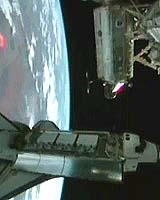
Station Gets New Job As Shuttle Pit Stop
Arlington - Jun 30, 2003 The Columbia Accident Investigation Board today issued its third preliminary recommendation to the National Aeronautics and Space Administration, in advance of its appearance in the final report. Recommendation Three: Before return to flight, for missions to the International Space Station (ISS,) develop a practicable capability to inspect and effect emergency repairs to the widest possible range of damage to the Thermal Protection System (TPS,) including both tile and Reinforced Carbon Carbon (RCC,) taking advantage of the additional capabilities available while in proximity to and docked at the ISS. Before return to flight, for non-station missions, develop a comprehensive autonomous (independent of station) inspection and repair capability to cover the widest practicable range of damage scenarios. An on-orbit TPS inspection should be accomplished early on all missions, using appropriate assets and capabilities. The ultimate objective should be a fully autonomous capability for all missions, to address the possibility that an ISS mission does not achieve the necessary orbit, fails to dock successfully, or suffers damage during or after undocking. Facts: At present there is no certified on-orbit or on-station capability to inspect the orbiter TPS for damage, or to effect repairs. Past efforts, some predating STS-1, have not resulted in an operational capacity. Changes in imaging and inspection capabilities, materials technology, and the access provided by the ISS have greatly improved the prospects for deploying this capability. Finding: An inspection of the TPS, accomplished as soon as possible after achieving orbit/rendezvous, coupled with repair capability, would result in improved safety. Background: The Board is convinced of the necessity of taking all practicable steps to "de-couple" foam insulation shedding from loss of crew and vehicle, including: 1) design improvements to prevent foam shedding; 2) toughening the TPS; 3) improved TPS inspection and repair capability. An inspection and repair capability is fundamental to improving the ability of the orbiter to experience TPS damage without catastrophic consequences. This effort does not reduce the urgency or importance of aggressively reducing all sources of potential damage to the orbiter. Only by reducing the likelihood of damage to the orbiter, as well as developing the ability to detect and repair damage, can the maximum safety improvement be realized. During the STS-107 flight and investigation, the lack of repair capability was cited repeatedly, and may have been a factor in decisions made during the STS-107 mission, including the decision not to seek images which might have assisted in the assessment of damage resulting from the foam strike on ascent. For Immediate Release CAIB PA 36-03 Related Links Columbia Accident Investigation Board SpaceDaily Search SpaceDaily Subscribe To SpaceDaily Express  T-Rays Uncover Defects in Space Shuttle Foam Sample
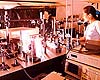 Troy - Jun 12, 2003
Using a technique pioneered by researchers at Rensselaer Polytechnic Institute, terahertz (THz) radiation has been used to uncover small defects in a sample of space shuttle foam. This nondestructive method could help National Aeronautical and Space Administration (NASA) officials examine the insulating foam that is applied to each shuttle's fuel tank prior to launch. |
|
|

| The content herein, unless otherwise known to be public domain, are Copyright 1995-2006 - SpaceDaily.AFP and UPI Wire Stories are copyright Agence France-Presse and United Press International. ESA PortalReports are copyright European Space Agency. All NASA sourced material is public domain. Additionalcopyrights may apply in whole or part to other bona fide parties. Advertising does not imply endorsement,agreement or approval of any opinions, statements or information provided by SpaceDaily on any Web page published or hosted by SpaceDaily. Privacy Statement |