|
 |
 |
 |
 |
 |
 |
 |
 |
 |

| . |  |
. |
Study Pinpointing Origins Of Siberian Peat Bogs Raises Concerns
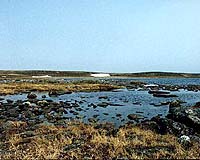
Arlington - Jan 21, 2004 Massive Siberian peat bogs, widely known as the permanently frozen home of untold kilometers of moss and uncountable hordes of mosquitoes, also are huge repositories for gases that are thought to play an important role in the Earth's climate balance, according to newly published research by a team of U.S. and Russian scientists in the Jan. 16 edition of the journal Science. Those gases, carbon dioxide and methane, are known to trap heat in the Earth's atmosphere, but the enormous amounts of the gases contained in the bogs haven't previously been accounted for in climate-change models. The new research, said Laurence Smith, an associate professor at the University of California, Los Angeles and a primary author on the paper, could help to refine those materials. Smith's work was funded by the National Science Foundation (NSF), an independent federal agency that supports fundamental research and education across all fields of science and engineering. A key finding of the research, unrelated to modern climate change, is that the bogs themselves came into being suddenly about 11,500 to 9,000 years ago-much earlier than previously thought-and expanded very rapidly to fill the niche they now occupy. Their appearance coincides with an abrupt and well- documented spike in the amount of atmospheric methane recorded in ancient climate records. The finding counters previously held views that the bogs were largely unchanged-and unchanging-over millennia. The rapid appearance of the bogs provides strong evidence that this is not the case. Scientists have hotly debated the origin of the methane spike, variously attributing it to sources in tropical wetlands and offshore sediments. The new research conclusively points for the first time to Siberia as a likely methane source. But the researchers also point out that the bogs-which collectively cover an area of roughly 603,000 square kilometers (233,000 square miles)-have long absorbed and held vast amounts of carbon dioxide, while releasing large amounts of methane in the atmosphere. If, as many scientists predict, a regional Arctic warming trend thaws the bogs and causes the trapped gases to be released into the atmosphere, that could result in a major and unexpected shift in climate trends, according to the researchers. The teams spent three seasons in the Siberian Arctic, drilling several meters down into the sphagnum moss to produce the peat samples for analysis. Smith said thawing of the permafrost would essentially turn the carbon and methane balance in the peat bogs from a scientific constant in climate-change equations to a variable. "Traditionally, we had thought these areas were simply a gradually varying source of methane and an important sink for atmospheric carbon," he said. "They've been viewed as a stable thing that we always count on. The bottom line is Siberian peat lands may be a bigger player in climate change than we knew before." "There are natural sources of greenhouse gases out there that are potentially enormous that we need to know about," Smith said. "One of the concerns is that up until now, the bogs have been more or less a sink for CO2, absorbing carbon dioxide from the atmosphere. In an extreme scenario, not only would they stop taking up CO2, they would release a lot of the carbon they have taken up for centuries." Smith conceded that the team searched their Siberian peat samples for evidence that such a drastic release of gas occurred in the past, with inconclusive results. But, he added, as other research into Earth's ancient climate begins to yield evidence that changes have occurred before, accounting for unknowns such as the carbon and methane balance in the bogs becomes more important. "It emphasizes a point that has been emerging over the past few years; the idea that the climate system is highly unpredictable and full of thresholds that can trigger greenhouse gas sources and sinks to abruptly switch on and off," he said. "The more of them we can identify, the more accurately we can model and anticipate changes in the future." Related Links National Science Foundation SpaceDaily Search SpaceDaily Subscribe To SpaceDaily Express  A "Hot Tower" Above The Eye Can Make Hurricanes Stronger
 Greenbelt - Jan 21, 2004
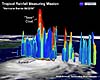
They are called hurricanes in the Atlantic, typhoons in the West Pacific, and tropical cyclones worldwide; but wherever these storms roam, the forces that determine their severity now are a little less mysterious. NASA scientists, using data from the Tropical Rainfall Measuring Mission (TRMM) satellite, have found "hot tower" clouds are associated with tropical cyclone intensification. |
|
|

| The content herein, unless otherwise known to be public domain, are Copyright 1995-2006 - SpaceDaily.AFP and UPI Wire Stories are copyright Agence France-Presse and United Press International. ESA PortalReports are copyright European Space Agency. All NASA sourced material is public domain. Additionalcopyrights may apply in whole or part to other bona fide parties. Advertising does not imply endorsement,agreement or approval of any opinions, statements or information provided by SpaceDaily on any Web page published or hosted by SpaceDaily. Privacy Statement |