 |
 |
 |
 |
 |
 |
 |
 |
 |
 |

| . |  |
. |
Sunny lunar mountain good site for base
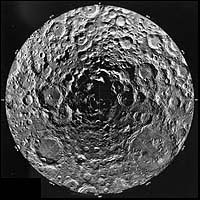
Houston (UPI) March 19, 2004 Scientists have discovered a mountain on the moon where the sun never sets, which might become the site of a U.S. moonbase. The "peak of eternal light," as it is called, is on the rim of Peary, a 50-mile-wide crater at the lunar north pole. The peak, announced by scientists from Johns Hopkins University at a meeting of astronomers in Houston, was discovered by analyzing images take of the moon's poles by the Clementine spacecraft in 1994. Because the moon's axis of rotation is tilted by about 1.5 degrees, it experiences small but detectable seasons at its poles. Earth's tilt, by contrast, is 23.5 degrees. Although the low tilt angle means there are crater floors and walls at the poles that never see the sun at all, at least one mountain always protrudes into the sunlight. Finding the permanently illuminated peak means the lunar north pole might be a good place to build Earth's first moonbase, the scientists said. The location probably has daily temperature changes of only about 70 degrees Fahrenheit, making lunar base operations easier than at the lunar equator where temperature changes are as much as 450 degrees daily. All rights reserved. Copyright 2004 by United Press International. Sections of the information displayed on this page (dispatches, photographs, logos) are protected by intellectual property rights owned by United Press International. As a consequence, you may not copy, reproduce, modify, transmit, publish, display or in any way commercially exploit any of the content of this section without the prior written consent of by United Press International. Related Links SpaceDaily Search SpaceDaily Subscribe To SpaceDaily Express  Lunar Convoys As An Option For A Return To The Moon
 Madison - Mar 02, 2004
The scientific community now believes there is water on the Moon. To some, this suggests a grand opportunity, and so it can be. However, the Moon's water, if there, is thought to be located near the poles, in deep, permanently-shadowed craters, as ice that is possibly buried, or at least mixed with lunar regolith. Special equipment will be needed to mine this enabling resource. A practical way to go after the lunar water is with the resources of a lunar colony. |
|
|

| The content herein, unless otherwise known to be public domain, are Copyright 1995-2006 - SpaceDaily.AFP and UPI Wire Stories are copyright Agence France-Presse and United Press International. ESA PortalReports are copyright European Space Agency. All NASA sourced material is public domain. Additionalcopyrights may apply in whole or part to other bona fide parties. Advertising does not imply endorsement,agreement or approval of any opinions, statements or information provided by SpaceDaily on any Web page published or hosted by SpaceDaily. Privacy Statement |