|
 |
 |
 |
 |
 |
 |
 |
 |
 |

| . |  |
. |
TIMED Mission Extended For Second Time
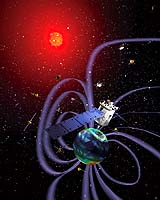
Laurel MD (SPX) May 26, 2006 NASA announced Thursday it is extending the Thermosphere, Ionosphere, Mesosphere Energetics and Dynamics spacecraft's mission for another four years, through 2010. Since its launch in 2001, TIMED has been collecting atmospheric and near-space data during various phases of the solar cycle. This next phase will investigate the response of Earth's middle and upper atmosphere � also known as the Mesosphere and Lower Thermosphere/Ionosphere, or MLTI - to solar and geomagnetic phenomena not previously observed during the last 11 year solar cycle. TIMED scientists will begin to obtain long-term measurements of the Sun's activities and effects on the MLTI. The aim is to improve understanding of the region's variability and its effects on communications, satellite tracking, spacecraft lifetimes, degradation of spacecraft materials and the reentry of piloted vehicles. TIMED also will join the Heliophysics Great Observatory - a collection of NASA's Sun-Earth-focused missions. "TIMED is a key mission within the Great Observatory focusing on the combined Sun-Earth effects on our planet's middle and upper atmosphere," said Sam Yee, TIMED project scientist at Johns Hopkins University's Applied Physics Laboratory, which built the spacecraft and supervises its scientific investigations. "During the next phase of our mission, we'll embark on new investigations to better understand the mechanisms leading to the escape of our upper atmosphere" Yee said. "Investigating the processes behind the loss of oxygen and hydrogen will help us understand the evolution of other planetary atmospheres including Venus and Mars." TIMED's continued study of solar effects on Earth's atmosphere also is intended to prepare scientists for future NASA HGO missions, such as those within its Living With a Star program, which focuses on better understanding the Sun's effects. NASA's Goddard Space Flight Center will manage the extended mission. Related Links TIMED  Two APL-built Instruments Observe Recent Total Solar Eclipse
 Laurel MD (SPX) May 26, 2006
Space scientists from the Johns Hopkins University Applied Physics Laboratory (APL), in Laurel, Md., got a first-hand look at what happens to Earth's atmosphere when the sun was abruptly "turned off" during the March 29, 2006, total solar eclipse. |
|
|

| The content herein, unless otherwise known to be public domain, are Copyright 1995-2006 - SpaceDaily.AFP and UPI Wire Stories are copyright Agence France-Presse and United Press International. ESA PortalReports are copyright European Space Agency. All NASA sourced material is public domain. Additionalcopyrights may apply in whole or part to other bona fide parties. Advertising does not imply endorsement,agreement or approval of any opinions, statements or information provided by SpaceDaily on any Web page published or hosted by SpaceDaily. Privacy Statement |