|
 |
 |
 |
 |
 |
 |
 |
 |
 |

| . |  |
. |
The SIXS Instrument By Finnish Astronomers Goes To Mercury
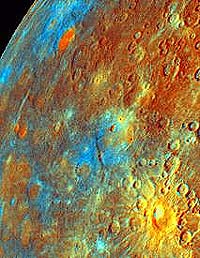
Helsinki, Finland (ESA) Feb 16, 2006 The European Space Agency (ESA) is launching a mission to Mercury, in which there is significant Finnish involvement. On Thursday 9 February 2006, the Science Programme Committee of the ESA held a meeting to approve the agency's next cornerstone programme, the spacecraft named BepiColombo, which is due to be launched towards Mercury in 2013. The ESA is building a planetary probe which will end up on a low elliptical orbit around Mercury for at least one year. The orbiter will carry with it cameras which can take accurate images of different wavelengths of the surface of this exotic and little-known planet, and also equipment for measuring local particle radiation and the intensity of the Sun. The Finns will be strongly involved especially in these measurements with their instrument built in Finland.
SIXS Measures The Sun's X-Ray And Particle Radiation In the spring of 2004, a consortium from Finland responded with their proposal to the Announcement of Opportunity to build scientific instruments for the planetary probe of ESA's BepiColombo. In the autumn of the same year, the proposal led by the Department of Astronomy at the University of Helsinki for equipment for measuring X-radiation and particle radiation was officially approved as one of the payload elements of BepiColombo. The Principal Investigator for the instrument called SIXS (Solar Intensity and particle X-ray Spectrometer) is Dr Juhani Huovelin from the Department of Astronomy. Finnish researchers are also involved at a Co-Principal Investigator (Co-PI) level for the British MIXS (Mercury Imaging X-ray Spectrometer) X-ray camera, which will map the elemental abundances of the surface of Mercury. The Finnish Co-PI of MIXS is Dr Karri Muinonen, also from the Department of Astronomy at the University of Helsinki. The Finnish consortium for these projects also include researchers from the Departments of Physical Sciences and Chemistry of the University of Helsinki and from the Finnish Meteorological Institute. Several commercial companies are involved as sub-contractors. Their task is to make the technical design and procure the equipment. In addition to the Mercury Planetary Orbiter (MPO) to be launched in August 2013, the spacecraft will also carry a Japanese Mercury Magnetospheric Orbiter (MMO), which contains special equipment for measuring the planet's magnetosphere and the magnetic field. This package of two orbiters will reach a permanent orbit around Mercury at the end of next decade, and will produce scientific data only in 2018�20, which makes BepiColombo a very long term project. Cornerstone missions like BepiColombo are the key elements in the European Space Agency's long-term scientific plan.
MIXS And SIXS Will Increase Finland's Hi-Tech Expertise And Raise The Level Of Science The design and construction of the orbiter's scientific payload is taking place in co-operative projects under the leadership of researchers from ESA's member states, and they are funded mainly by the member states themselves. Usually several countries are involved in the construction of the equipment, because the development of entirely new technology for the cutting-edge equipment needs expertise from many fields, and for missions into Space, only the best is good enough. The design of a new generation of equipment that can operate reliably in Space for years without any maintenance is also expensive, and these days, the Space-related budget of small countries is barely sufficient for the construction of even one device. About one million euros a year over several years is being spent on the Finnish SIXS instrument and the Finnish contribution in the MIXS camera. This investment, which is already being funded by Tekes (the National Technology Agency in Finland) for the first year, is improving the instrument group's expertise and international competitiveness in high technology, the benefits of which may be reaped many times over in the long term. On the other hand, the instrument science group will be able to utilise their own instrument data very effectively, being internationally competitive in the science achievements obtained with this mission. Related Links University of Helsinki  Messenger Engine Burn Puts Spacecraft On Track For Venus
 Baltimore MD (SPX) Dec 13, 2005
At 6:30 a.m. (EST) Monday NASA's Mercury-bound Messenger spacecraft successfully fired its large bipropellant thruster for the first time since launch, completing the first of several critical deep space maneuvers that will help the spacecraft reach Mercury orbit. |
|
|

| The content herein, unless otherwise known to be public domain, are Copyright 1995-2006 - SpaceDaily.AFP and UPI Wire Stories are copyright Agence France-Presse and United Press International. ESA PortalReports are copyright European Space Agency. All NASA sourced material is public domain. Additionalcopyrights may apply in whole or part to other bona fide parties. Advertising does not imply endorsement,agreement or approval of any opinions, statements or information provided by SpaceDaily on any Web page published or hosted by SpaceDaily. Privacy Statement |