|
 |
 |
 |
 |
 |
 |
 |
 |
 |

| . |  |
. |
Titan Offers Clues To Early History Of Earth
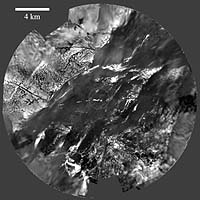
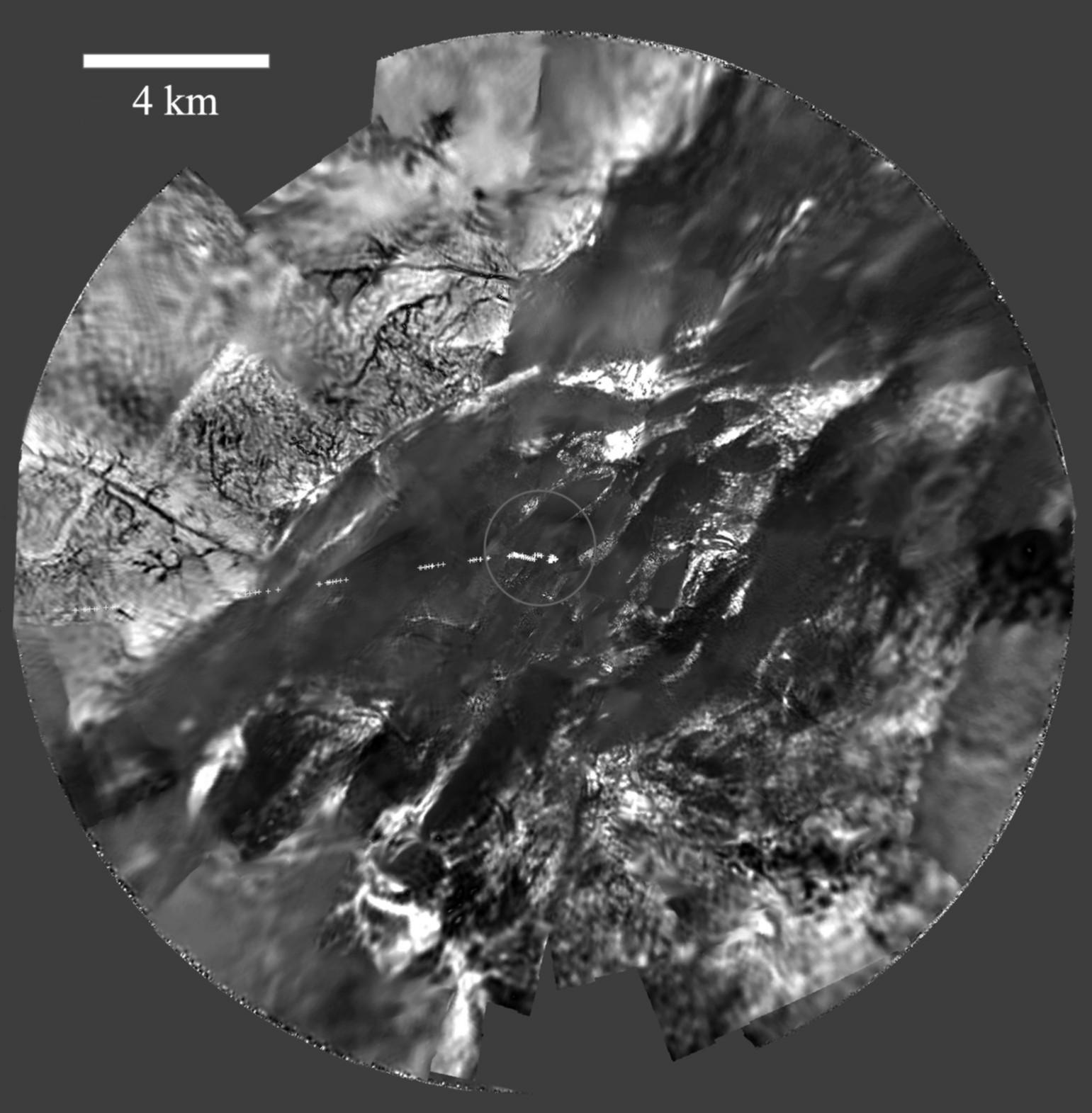
Ann Arbor MI (SPX) Dec 01, 2005 Readings from the Huygens probe of the surface and atmosphere around Saturn's largest moon, Titan, give researchers a peek back through time to when and how Earth's atmosphere formed, and how our primitive planet looked before life took a foothold here. The Huygens space probe, launched from the Cassini spacecraft Dec. 25, 2004, took the first direct measurements of Titan's atmosphere and surface as it parachuted onto the moon on Jan.14. The instrument that made the measurements, called Gas Chromatograph Mass Spectrometer (GCMS), was built by the Goddard Space Flight Center and the University of Michigan. The new findings are outlined in the paper, "The Abundances of Constituents of Titan's Atmosphere From the GCMS Instrument on the Huygens Probe," available in the on-line edition of the journal Nature. The spectrometer recorded several new and important findings, said Sushil Atreya, U-M professor of atmospheric, oceanic, and space sciences and a member of the team who, together with George Carignan, AOSS Research Scientist Emeritus, helped design the spectrometer, and interpret the readings. Atreya also directs the Planetary Science Laboratory. The first, and perhaps most significant discovery, is that the spectrometer did not detect the primordial noble gases. Their detection would have signaled that the atmosphere on Titan today is the same as acquired at the time of Titan's formation. Instead, nitrogen on Titan formed from ammonia, which is believed to be the same way nitrogen formed on Earth. "Titan and Earth have a lot of similarities from the very beginning," Atreya said. "The most important aspect of Titan is that it has an Earth-like atmosphere. No other body in the solar system outside Earth has a massive nitrogen atmosphere. It's like a window into the past of the Earth. It tells us the conditions the way they were when Earth began to form, the way the atmosphere came about." The spectrometer also discovered that methane is the second most abundant gas on Titan, comprising five percent of the atmospheric volume. Surprisingly, methane was found to play a similar role on Titan as does water in the hydrological cycle on Earth. The spectrometer measurements indicated presence of small amounts of liquid methane mixed in with other surface material; this methane evaporates into the atmosphere and forms clouds (as does water on Earth) and eventually rains back down and completes the cycle. "It's telling us that Titan's meteorology is somewhat like the meteorology on Earth, except Titan's meteorology is controlled by methane and Earth's is controlled by water," Atreya said. Another important aspect of Titan is that complex hydrocarbons form in the presence of methane and nitrogen (the two main components of Titan's atmosphere) and the energy from the sun. Reactions can occur here that create complex organic molecules that may be the precursors to life, Atreya said. The spectrometer data provide no indication of life on Titan. In the cold environment of Titan, the complex organic molecules condense to form the haze that hovers from approximately 16 kilometers to perhaps as high as 700 km above Titan's surface, and obscures the moon's surface from view. In another paper, also available in this issue of Nature, preliminary results on this haze collected by the Aerosol Collector Pyrolyzer (ACP) instrument during Huygen's descent through Titan's atmosphere and analyzed by the GCMS are presented.

|