|
 |
 |
 |
 |
 |
 |
 |
 |
 |

| . |  |
. |
Titan's Big Surprise
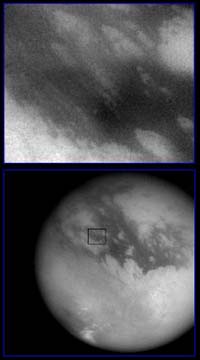
Moffett Field (SPX) Oct 28, 2004 Instruments aboard the Cassini spacecraft have sent back the most detailed images ever captured of the surface of Saturn's giant moon, Titan. They've also presented scientists with a major mystery. There's a huge cloud formation over the moon's south pole, spanning 1000 kilometers at its widest. That's no surprise; scientists expected it to be there. But they also expected it to be made of methane. And it isn't. There's lots of methane in Titan's atmosphere. It was detected many years ago by spacecraft that flew past the ringed planet. So when recent images from the Keck Observatory in Hawaii showed clouds at Titan's south pole, scientists assumed they were methane clouds. According to their model, Titan is so cold that methane can form liquid pools on its surface. When this liquid is heated by the sun, it evaporates, forming methane clouds. Water clouds on Earth work the same way. The sun heats the ocean, water evaporates and clouds form in the atmosphere. Because Titan's south pole is currently pointed toward the sun, it is receiving the greatest amount of heat right now. So a massive cloud form over the south pole fits the model perfectly - if the cloud is made of methane. But, according to data gathered by Cassini, the particles that make up the cloud are too big to be methane. "I don't believe it," says Chris McKay, a planetary scientist with the NASA Ames Research Center in Moffett Field, California. "What else can they be? It would be like flying over Earth and saying the clouds are not water. If those clouds are really not methane, then a lot of the things we think about Titan are wrong. A lot of things we think about those clouds are wrong - the whole explanation of why they're there." The Cassini science team has not yet had time to fully analyze the data sent back by the spacecraft, so they don't yet know what the clouds are made of. One possibility, McKay speculates, is ethane. But ethane, he says, is a photochemical product that is produced in the upper atmosphere and rains downward. So it wouldn't make sense that a massive ethane cloud would appear at the south pole. Another possibility, he says, is that "it's some sort of organic goo. It could be some sort of organic polymer, essentially plastic particles. Maybe little polystyrene foam balls. Who knows?" But, as with ethane, these would form from above. There's no known reason why a massive cloud of them should form at Titan's south pole. And so, McKay concludes, freely admitting that his off-the-cuff theory is "based on no data," that the clouds "are formed of methane, and that there's some process which is hiding the spectral signatures of the methane." One plausible scenario is that the cloud particles could start out as methane, produced as expected on the ground and carried aloft. Once airborne, however, they become coated with some other substance, perhaps ethane. Further study of the spectral data collected by Cassini, together with lab-based experiments should enable scientists to unravel the mystery, but it will take some time for them to do so. Meanwhile, down on Titan's surface, another mystery is unfolding. Recent images have revealed stunning surface detail, never before seen. But, according to Caroline Porco, team leader for the imaging science subsystem, "we don't know exactly what we're looking at." The "don't know" part applies both to the moon's surface composition and to its topography. Figuring out what the moon is made of should be relatively easy, using data from Cassini's VIMS (Visual and Infrared Mapping Spectrometer) instrument. Different materials reflect light at different frequencies. Each pixel captured by VIMS records the strength of the light reflected at each of 352 distinct frequencies. Some of these frequencies are visible to human eyes, others are in the infrared. By analyzing this spectral data, scientists should be able to figure out Titan's surface composition. The analysis requires intensive computation, matching the observed spectra to standards stored in spectral libraries here on Earth. Early results should be available within a few days. Titan's topography will be a tougher nut to crack. Because of the global haze layer, Porco says, "we do not see shadows on the surface of Titan. And because we don't see shadow, we can't look at an image and immediately deduce what's up and what's down." There could be massive mountains and deep valleys there, or the surface could be completely flat. At this point, there's no way to tell. Titan is unlike Mars and the icy moons of Jupiter, which have little or no atmosphere. So the "techniques that we've used for interpreting airless bodies, all those methods of examining solid surfaces from planetary spacecraft that we have learned over the last half century," don't apply, says Porco. "We can't use that on Titan, because it's a very different environment." What scientists can use is a combination of data from several different Casssini instruments, collected over a long period of time. During its 4-year mission, Cassini will make many more close passes by Titan, 45 in all. During these future flybys, Cassini will collect both radar data - the first such data was captured during Tuesday's flyby - and stereo images. By integrating these two types of data, the Cassini science team will be able slowly to build up a picture of Titan's topography. That process, however, will take months - or even years. Related Links Cassini at JPL Cassini Image Team SpaceDaily Search SpaceDaily Subscribe To SpaceDaily Express  In The Stars: Titan's Critical Secret
 Washington (UPI) Oct 28, 2004
NASA's Cassini spacecraft just flew closer to Saturn's giant moon Titan than any other device built by humans. The mission, in one of the far corners of the solar system, is attempting to answer a very large, critical question - does life exist anywhere else in the universe? |
|
|

| The content herein, unless otherwise known to be public domain, are Copyright 1995-2006 - SpaceDaily.AFP and UPI Wire Stories are copyright Agence France-Presse and United Press International. ESA PortalReports are copyright European Space Agency. All NASA sourced material is public domain. Additionalcopyrights may apply in whole or part to other bona fide parties. Advertising does not imply endorsement,agreement or approval of any opinions, statements or information provided by SpaceDaily on any Web page published or hosted by SpaceDaily. Privacy Statement |