|
 |
 |
 |
 |
 |
 |
 |
 |
 |

| . |  |
. |
UK Scientists Sift Superfine Stardust
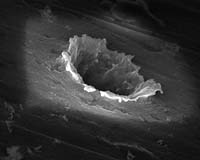
Leicester UK (SPX) Apr 19, 2007 UK scientists are preparing to analyse miniscule impact craters collected by NASA's Stardust mission as it flew through interstellar dust streams. These craters contain the residues of the dust particles that are the seeds of our own Solar System. A UK consortium of researchers from the University of Leicester, Natural History Museum, Kent University, Glasgow University and Open University have been studying the cometary samples which were delivered a few weeks after the samples were returned to Earth. The interstellar dust particles are about ten nanometres across (one hundred thousandth of a millimetre) and they are even smaller than many of the particles that Stardust collected when it flew through the coma of Comet Wild 2. In a presentation at the Royal Astronomical Society's National Astronomy Meeting in Preston on 18th April, Dr John Bridges from the University of Leicester will describe how techniques developed to analyse material from the comet's tail will be used to study the interstellar particles. A focussed beam of electrically charged particles will be used to extract the residue of the dust from the craters. Once the material is no longer shielded by the crater walls, it can be examined using a transmission electron microscope. "The interstellar dust particles collected by Stardust are so tiny that they pose huge analytical challenges," said Dr Bridges. "Having spent the time perfecting our techniques and analysing Comet Wild 2, we are very excited by the prospect of these samples. "Our analysis of samples from the comet's tail revealed that its composition was more complex than we'd thought and indicated an unexpected mixing of refractory and volatile material in the early Solar System. The interstellar particles will take us one step farther back and allow us to look at the composition of the dust cloud from which the Solar System formed." The Stardust mission spent 4 months collecting interstellar dust during its 2.88 million mile journey to Comet Wild-2 and back to Earth. The return capsule, containing the dust and samples from the comet's tail, landed in the desert in Utah in January 2006. Since then, samples have been distributed to selected researchers around the world. Email This Article
Related Links  London UK (SPX) Apr 19, 2007
Most of the matter in the Universe is not the ordinary kind made up of protons, neutrons, and electrons, but an elusive "dark matter" detectable only from its gravity. Like a tenuous gas, dark matter is all around us - it goes through us all the time without us noticing - but tends to collect in large quantities around galaxies and clusters of galaxies and makes up about one-sixth of the mass of the Universe. |
|
|

| The content herein, unless otherwise known to be public domain, are Copyright 1995-2006 - SpaceDaily.AFP and UPI Wire Stories are copyright Agence France-Presse and United Press International. ESA PortalReports are copyright European Space Agency. All NASA sourced material is public domain. Additionalcopyrights may apply in whole or part to other bona fide parties. Advertising does not imply endorsement,agreement or approval of any opinions, statements or information provided by SpaceDaily on any Web page published or hosted by SpaceDaily. Privacy Statement |