 |
 |
 |
 |
 |
 |
 |
 |
 |
 |

| . |  |
. |
US satellite shoot-down part of space 'arms race': Russia
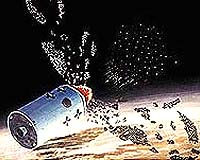
Moscow (AFP) Feb 17, 2008 Moscow fears a US plan to shoot down a damaged spy satellite in the coming weeks is a veiled weapons test and represents an "attempt to move the arms race into space," Russia's defence ministry said. The operation, which Washington says is motivated only by the desire to avoid a damaging crash on Earth, "does not look as innocent as they are trying to present it," the ministry said in a statement released late Saturday. "The impression arises that the United States is trying to use the accident with its satellite to test its national anti-missile defence system as a means of destroying satellites," the Russian ministry said. The ability to shoot down satellites is seen by many analysts as crucial in future conflicts due to the dependence of modern military equipment on satellite-based communications. Washington says a US warship will fire a surface-to-air missile at the US satellite, which is roughly the size of a bus, to ensure any Earth-bound debris will splash into the ocean. Without intervention, the satellite would hit earth in early March, a US official said. The United States denies the shoot-down aims at protecting the satellite's technological secrets or at demonstrating anti-satellite capability. However, the Russian defence ministry said the US plan was "in many ways close" to China's controversial shoot-down of an old weather satellite in January, which was condemned by the United States as a demonstration of its military reach in space. The US State Department last week said that the Chinese operation was "designed specifically" to test their ability to destroy satellites, whereas the US plan was aimed only at protecting people on the ground. Russian concerns about the US plan are compounded by Washington's repeated refusal to take part in talks on limiting space-based weapons, the defence ministry said. The announcement last week that Moscow and Beijing were proposing a new treaty banning the use of weapons in space was immediately rejected by the White House.
earlier related report "He's not bluffing when he talks about the danger posed by this satellite," the unnamed Russian official told Interfax and RIA Novosti news agencies, referring to comments made Thursday by General James Cartwright, vice chairman of the US Joint Chiefs of Staff. The United States says the satellite is the size of a bus and contains a large quantity of hydrazine, an extremely toxic propellant. The chemical could be dangerous to people on the ground if the satellite -- currently in Earth orbit but being pulled down by Earth's gravity -- does not burn up on re-entry, it says. Washington says a US warship will fire a surface-to-air missile at the satellite at a specific point in its orbit that ensures any Earthbound debris will splash into the ocean. It denies the shoot down aims at protecting the satellite's technological secrets or at demonstrating US anti-satellite capability. A senior Russian parliamentarian echoed the defence ministry's concerns. "The trajectory of the satellite's descent is unclear, but there is every likelihood it could fall on Russian territory," the deputy head of parliament's defence committee, Igor Barinov, told Interfax. But Barinov also said he hoped Washington was not trying to flex its military muscles. "If this is the Americans' answer to China's latest action in shooting down its faulty weather satellite, and if such a decision is aimed at demonstrating American power, then it could lead to a new escalation in the military sphere," he warned. In January 2007, China tested an anti-satellite missile against an old Chinese weather satellite. That operation sparked concerns of a military space race, as well as angry complaints that whirling debris from the smash-up could imperil low-orbiting satellites. On Tuesday, Russian Foreign Minister Sergei Lavrov announced that Moscow and Beijing were proposing a new treaty banning the use of weapons in space. The call was immediately rejected by the White House, which said ensuring compliance of such a deal was "impossible." In France on Friday, space debris expert Marc Pircher said there seemed little risk that the planned shoot down would add to the growing problem of orbital junk. Interception will take place at a height of 200 kilometres (120 miles), where atmospheric molecules will brake debris trajectory and Earth's intense gravitational pull will ensure that pieces burn up within a few weeks, he predicted. "However, they have to be careful to ensure there is no impediment to working orbits, including by the International Space Station," which orbits at a height of around 340 kilometres (212 miles), said Pircher, director of the Toulouse Space Centre, run by France's National Centre for Space Research (CNES). In Geneva, Christina Rocca, the US chief representative at the Conference on Disarmament, said that, without intervention, the satellite would fall to Earth "on or about" March 6, in almost any region outside the polar circles. Community Email This Article Comment On This Article Related Links Military Space News at SpaceWar.com
 US seeks to reassure world about bid to destroy crippled satellite
 Washington (AFP) Feb 15, 2008
The United States said Friday it is reassuring nations worldwide about its bid to destroy a crippled spy satellite, adding it is unlike China's controversial anti-satellite test last year. |
|
|

| The content herein, unless otherwise known to be public domain, are Copyright 1995-2007 - SpaceDaily.AFP and UPI Wire Stories are copyright Agence France-Presse and United Press International. ESA Portal Reports are copyright European Space Agency. All NASA sourced material is public domain. Additional copyrights may apply in whole or part to other bona fide parties. Advertising does not imply endorsement,agreement or approval of any opinions, statements or information provided by SpaceDaily on any Web page published or hosted by SpaceDaily. Privacy Statement |