|
 |
 |
 |
 |
 |
 |
 |
 |
 |

| . |  |
. |
UVic Unveils World's Most Advanced Seafloor Observatory
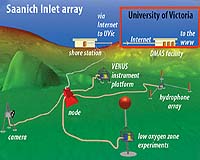
Victoria BC (SPX) Nov 18, 2005 A project led by the University of Victoria is about to make oceanographic history. VENUS, the world's most advanced, cabled seafloor observatory, will be installed next month in the waters of Saanich Inlet north of Victoria, British Columbia. VENUS (the Victoria Experimental Network Under the Sea) pioneers a new approach to studying the oceans. Through the Internet, VENUS's underwater network of fibre optic cables and instruments will continuously feed data, sounds and images from the ocean depths to laboratories, classrooms, science centres and homes around the world. VENUS is interactive, meaning that ocean scientists will no longer be bound by the limitations of ship schedules, bad weather, or delayed access to research data. VENUS scientists will operate their instruments and download data online, day or night, in real time. "The installation of the VENUS observatory is a scientific milestone for UVic, for Canada and indeed for the world," said UVic President Dr. David Turpin today at a media briefing and reception to showcase VENUS technology before it is submerged in the sea. "The ocean surface is no longer a barrier to our curiosity. VENUS lets us all 'enter' the ocean whenever we wish and opens up a whole new era of ocean exploration." VENUS builds on UVic's recognized strengths in ocean sciences and we're very proud of the hard work, strong partnerships, and innovative thinking that have brought us to this exciting threshold." VENUS is funded by $10.3 million from the Canada Foundation for Innovation, the British Columbia Knowledge Development Fund, and other contributions from federal agencies, industry and sponsors. "The VENUS observatory will contribute significantly to our understanding of the oceans and generate countless benefits for and the world," says Dr. Eliot Phillipson, president and CEO of the Canada Foundation for Innovation (CFI). "The CFI is a proud partner in this project that will help enhance Canada's well-deserved reputation as a place where outstanding, innovative research is being conducted." "VENUS will increase our understanding of the oceans in the same way that the Hubble Telescope is revolutionizing our knowledge of outer space," says B.C. Advanced Education Minister Murray Coell. "By taking risks and challenging traditional limits, the scientists of VENUS offer inspiration to the youth of B.C., and the rest of the world." VENUS will support two cable arrays. The Saanich Inlet array will extend 4 km into Patricia Bay, and reach depths of 100 metres. It comes ashore at Fisheries and Oceans Canada's Institute of Oceans Science. Another 40-km array will be installed in late 2006 in the Strait of Georgia near Vancouver. The VENUS project director is UVic biologist Dr. Verena Tunnicliffe, a world authority on deep sea life and the Canada Research Chair in Deep Ocean Research. "Over its 20-year lifespan, VENUS will grow as new extensions are added and new questions arise about the oceans," she says. "The scientific community will drive this growth." The main industrial partners for the Saanich Inlet array are Global Marine Systems and its North Vancouver-based subcontractor, OceanWorks International Inc. Global Marine operates the cable-laying ship, CS Wave Venture. VENUS features technologies developed in B.C. "The VENUS project further advances our commercial expertise into the cutting edge of undersea research," says Gabriel Ruhan, managing director of Global Marine. "We're very pleased to be working with UVic on this important project and we look forward to supporting our relationships throughout the undersea research community." "We're very excited to be a part of the VENUS project," says Glen Viau, sales and commercial manager at OceanWorks. "The unique challenges involved in the project have given us an opportunity to showcase local capabilities in subsea technology. UVic and the VENUS team are leading the world with this ground-breaking project and OceanWorks is grateful for the chance to participate." Related Links University of Victoria Global Marine Systems OceanWorks International SpaceDaily Search SpaceDaily Subscribe To SpaceDaily Express  Climate Warming To Shrink Key Water Supplies Around The World
 San Diego CA (SPX) Nov 16, 2005
In the looming future global warming will reduce glaciers and storage packs of snow in regions around the world causing water shortages and other problems that will impact millions of people. |
|
|

| The content herein, unless otherwise known to be public domain, are Copyright 1995-2006 - SpaceDaily.AFP and UPI Wire Stories are copyright Agence France-Presse and United Press International. ESA PortalReports are copyright European Space Agency. All NASA sourced material is public domain. Additionalcopyrights may apply in whole or part to other bona fide parties. Advertising does not imply endorsement,agreement or approval of any opinions, statements or information provided by SpaceDaily on any Web page published or hosted by SpaceDaily. Privacy Statement |