 |
 |
 |
 |
 |
 |
 |
 |
 |
 |

| . |  |
. |
United Defense Integrates And Fires ETC Gun From Combat Vehicle
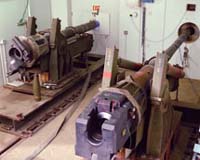
Minneapolis MN (SPX) Sep 14, 2004 United Defense Industries achieved an industry first recently when it successfully fired a 120mm Electrothermal Chemical (ETC) gun from a hybrid electric drive combat vehicle. This effort, using a fully integrated 100kJ pulse power system, was accomplished through a Cooperative Research and Development Agreement with the US Army's Armament Research Development and Engineering Center (ARDEC). ARDEC is the Army's center of excellence for armament systems development. "This series of tests demonstrated that pulse power can be safely integrated into a combat vehicle," said Brad Goodell, Advanced Armaments Program Manager at United Defense. "Both ETC and conventional rounds were fired in the same salvo merely by changing round selection through a fire control command." United Defense developed an autoloader that successfully loaded and ejected rounds and stub cases from the vehicle. Stub cases are steel cases that transport and hold the propellant. The fully automatic breech power connection, utilized in the demonstration, was designed such that electricity reached only the propellant, but not any other part of the cannon or vehicle. According to industry experts, ETC technology can significantly enhance accuracy of direct fire weapons, using pulsed power in conjunction with modified, fielded weapon systems and ammunition. The modification to the ammunition requires replacing the conventional igniter within the round with a plasma igniter. Plasma ignition significantly reduces the variations in projectile exit times. This increase in ignition control allows plasma ignition to become the critical element of an advanced fire control capability called "precision aiming." Precision aiming uses gun muzzle position sensors, advanced fire control algorithms, and plasma ignition to virtually eliminate gun pointing error. Reduction in pointing error increases accuracy, especially when the vehicle is moving and the pointing errors dominate. Vehicle survivability is also enhanced when using this ETC technology because engagements can be at longer range, and at higher cross country speeds. This technology has a broad range of applications, including applications to existing and future direct fire weapons platforms. Related Links United Defense SpaceDaily Search SpaceDaily Subscribe To SpaceDaily Express  DARPA Seeks Soldier Memory System
 Washington (UPI) Sep 13, 2004
The Pentagon is hoping to build a soldier-mounted camera, video and audio recording system to capture battlefield events. |
|
|

| The content herein, unless otherwise known to be public domain, are Copyright 1995-2006 - SpaceDaily.AFP and UPI Wire Stories are copyright Agence France-Presse and United Press International. ESA PortalReports are copyright European Space Agency. All NASA sourced material is public domain. Additionalcopyrights may apply in whole or part to other bona fide parties. Advertising does not imply endorsement,agreement or approval of any opinions, statements or information provided by SpaceDaily on any Web page published or hosted by SpaceDaily. Privacy Statement |