|
 |
 |
 |
 |
 |
 |
 |
 |
 |

| . |  |
. |
Upcoming Mercury Transit Whets The Appetite For MESSENGER
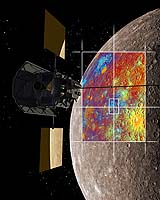
Laurel MD (SPX) Nov 07, 2006 On Wednesday, November 8, the planet Mercury will make a rare trek across the face of the Sun, beginning at 2:12 p.m. EST and lasting for nearly five hours. Observers in North and South America, Australia, and parts of Asia will have a good view; the transit also will be captured via a live Webcast that will include discussions on the science, technology, and history of the transit, as well as current knowledge of the Sun and space weather. Mercury transits don't happen very often. The last was on May 7, 2003, and the next doesn't come until May 9, 2016. The event underscores the importance of the NASA's Mercury-bound MESSENGER spacecraft, which will conduct the first orbital study of Mercury, the least explored of the terrestrial ("rocky") planets that also include Venus, Earth, and Mars. "There is still so much that we don't know about Mercury," says Deborah Domingue, MESSENGER's deputy project scientist and a planetary astronomer at the Johns Hopkins University Applied Physics Laboratory (APL) in Laurel, Md. The mission will attempt to answer several questions about the innermost planet, such as: Why is Mercury - the densest planet in the solar system - mostly made of iron? Why is it the only inner planet besides Earth with a global magnetic field? How can the planet closest to the Sun, with daytime temperatures as high as 840� degrees Fahrenheit, have what appears to be ice in its polar craters? "The last time we set our sights on Mercury was 30 years ago," Domingue notes, referring to NASA's Mariner 10 spacecraft, which sailed past the planet three times in 1974 and 1975 and gathered detailed data on less than half the surface. MESSENGER, carrying seven scientific instruments on its compact and durable composite frame, will provide the first images of the entire planet. The mission will also collect detailed information on the composition and structure of Mercury's crust, its geologic history, the nature of its thin atmosphere and active magnetosphere, and the makeup of its core and polar materials. Domingue will talk about MESSENGER (short for MErcury Surface, Space ENvironment, GEochemistry, and Ranging) during the transit Webcast, which is geared toward middle school students. "I'm going to talk about MESSENGER's science goals, the Mariner missions, and why it's so difficult to send a spacecraft into the inner solar system," she says. "So while this is geared to students, the general public should tune in if only to be reminded that NASA is still actively involved in exploration, and not just the outer planets. We are still boldly going where no one has gone before!" The hour-long "Transit of Mercury Webcast," hosted by the NASA Digital Learning Network, will begin at 1:30 p.m. EST. In addition to APL's Domingue, the event will feature: + panel discussions with scientists from NASA's Goddard Space Flight Center, educators and an amateur astronomer from NASA Langley Research Center; + two NASA "Explorer" schools, connected for a live questions-and-answer session; + a telescope "safety viewing" demonstration with instructions on how to view the transit using a classroom solarscope; + live images of the transit from two NASA satellites, SOHO and TRACE; and + live ground-based images from the Kitt Peak National Observatory in Arizona and the University of Hawaii's Mauna Kea telescopes. Related Links MESSENGER Web cast News Flash at Mercury  A Rare Transit Of Mercury Occurs On November 8
 Washington DC (SPX) Nov 01, 2006
Usually you expect to see planets at night. But in broad daylight on Wednesday, November 8th, the planet Mercury will cross the face of the Sun. It will be visible in silhouette through a telescope with a safe solar filter placed securely over the front. Mercury will "transit" the Sun for about five hours, looking like a tiny round sunspot creeping westward across the enormous surface of our home star. |
|
|

| The content herein, unless otherwise known to be public domain, are Copyright 1995-2006 - SpaceDaily.AFP and UPI Wire Stories are copyright Agence France-Presse and United Press International. ESA PortalReports are copyright European Space Agency. All NASA sourced material is public domain. Additionalcopyrights may apply in whole or part to other bona fide parties. Advertising does not imply endorsement,agreement or approval of any opinions, statements or information provided by SpaceDaily on any Web page published or hosted by SpaceDaily. Privacy Statement |