|
 |
 |
 |
 |
 |
 |
 |
 |
 |

| . |  |
. |
VLT Finds Very Cool Brown Dwarf In The Neighborhood
Tucson AZ (SPX) Mar 22, 2006 Astronomers have discovered a unique brown dwarf located, relatively speaking, right in the solar neighborhood. The rare object, designated SCR 1845-6357B, is only 12.7 light years away, circling a primary star that itself was discovered only recently in the southern hemisphere constellation Pavo, the Peacock. Only one other brown dwarf system has been found closer to Earth, and it is only marginally closer. The primary star is only one-tenth the mass of the Sun. This is the first time astronomers have found a cool brown dwarf companion to such a low-mass star. SCR 1845-6357B is located about 4.5 AU from its star, or four and one-half times farther than the distance from Earth to the Sun. Astronomers estimate the brown dwarf is between nine times and 65 times as massive as Jupiter. Brown dwarfs are neither planets nor stars. They are dozens of times more massive than Jupiter, the solar system's largest planet, but too small to be self-powered by hydrogen fusion like stars. Only about 30 similarly cool brown dwarfs have been found anywhere in the sky, and only about 10 have been discovered orbiting stars. "Besides being extremely close to Earth and in orbit around a very low-mass star, this object is a 'T dwarf' - a very cool brown dwarf with a temperature of about 750 degrees Celsius (1,382 degrees Fahrenheit)," said Beth Biller of The University of Arizona. "It is also likely the brightest known object of its temperature because it is so close," Biller added, "and it's a rare example of a brown dwarf companion within 10 astronomical units of its primary star." Biller, along with Markus Kasper of the European Southern Observatory and Laird Close of UA's Steward Observatory, led the team that discovered SCR 1845-6357B. "What's really exciting about this is that we found the brown dwarf around one of the 25 stellar systems nearest to the Sun," Close said. "Most of these nearby stars have been known for decades, and only just recently a handful of new objects have been found in our local neighborhood. If you think of the galaxy as being the size of Tucson, it's kind of like finding someone living in the upstairs of your house that you didn't know about before." Close helped develop the special adaptive optics camera, the Simultaneous Differential Imager, the team used to image the brown dwarf. The camera is used on ESO's Very Large Telescope in Chile. Another SDI camera is used at the 6.5-meter MMT Observatory on Mount Hopkins, Ariz. "This is also a valuable object to the scientific community, because its distance is well known," said ESO's Markus Kasper. This factor should enable astronomers to measure the brown dwarf's luminosity accurately and, eventually, calculate its orbital motion, he said. "These properties are vital for understanding the nature of brown dwarfs." Close said the discovery suggests there may be more cool brown dwarfs in binary systems than single brown dwarfs floating free in the solar neighborhood. In a binary system, a brown dwarf revolves around a star or another brown dwarf. In all, astronomers have found only five cool brown dwarfs in binary systems, and only two single, isolated cool brown dwarfs within 20 light years of the Sun, but Close said he thinks more T dwarf companions must lurk in other stellar systems within 33 light years of our solar system. He said evidence that T dwarfs in binary systems outnumber single, isolated T dwarfs in the solar neighborhood has ramifications for theories that predict single brown dwarfs will form more often than binary ones. The SDI uses adaptive optics to remove the blurring effects of Earth's atmosphere to produce extremely sharp images. The camera enhances the ability of the VLT to detect faint companions that would otherwise be lost in the glare of their primary stars. Close and Rainer Lenzen of the Max Planck Institute for Astronomy in Heidelberg, Germany, developed the SDI camera to search for methane-rich extrasolar planets. The SDI camera splits light from a single object into four identical images, then passes the beams through three slightly different methane-sensitive filters. When the filtered light beams hit the detector array, astronomers subtract the images so the bright star disappears and its far dimmer, methane-rich companion pops into view. The team will publish more details about the discovery in an upcoming issue of Astrophysical Journal Letters. Related Links SDI VLT ESO Atlas Of The Universe  Aurora Season Begins
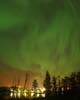 Hadley MA (SPX) Mar 21, 2006
"The kids started screaming when the sky changed. Even the teens were excited," says Rick Thayer of Hadley, Massachusetts. He and his family (including 6 teenagers from a nearby birthday party) were outdoors at sunset on Sept 7th 2005 when a solar wind gust hit Earth's magnetic field. The impact triggered colorful Northern Lights that people saw all the way from Europe to the western US. |
|
|

| The content herein, unless otherwise known to be public domain, are Copyright 1995-2006 - SpaceDaily.AFP and UPI Wire Stories are copyright Agence France-Presse and United Press International. ESA PortalReports are copyright European Space Agency. All NASA sourced material is public domain. Additionalcopyrights may apply in whole or part to other bona fide parties. Advertising does not imply endorsement,agreement or approval of any opinions, statements or information provided by SpaceDaily on any Web page published or hosted by SpaceDaily. Privacy Statement |