|
 |
 |
 |
 |
 |
 |
 |
 |
 |

| . |  |
. |
Wireless World: Spychips Invading Privacy?
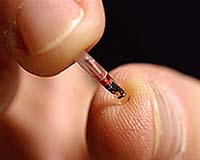
Chicago (UPI) Oct 7, 2005 Chips that track boxes on trucks and ships soon may be sophisticated enough to monitor every move of consumers, a controversial new book claims. Experts told UPI's Wireless World that radio frequency identification technology -- mentioned as a potential privacy-invading technology by Sen. Joe Biden, D-Del., during last month's confirmation hearings for Supreme Court Justice John Roberts -- is emerging as a political and legal issue, not just a technological one. The new book, "Spychips: How Major Corporations and the Government Plan to Track Your Every Move with RFID" (Nelson Current, October 2005), is written by Katherine Albrecht and Liz McIntyre, privacy advocates who have been investigating the impact of RFID technology. "Police will be able to track your every move when you drive," McIntyre told Wireless World. McIntyre's book claims RFID chips -- which emit a signal and can be tracked by special reader technologies -- are the "ultimate Big Brother." The book reports a major technology company is developing a "person tracking unit" that can scan RFID tags on the clothing of individuals as they travel on the train or through the shopping mall. The book also states another firm, a mobile-phone developer, is putting together a phone that can scan people as they walk by on the sidewalk. There are also plans in the works at major companies to use RFID to develop and deploy targeted advertising on individuals, the authors assert. Some experts are skeptical, however. The book hypes fears and the public needs to hear an "independent voice of reason" on the topic of RFID chips, said a spokeswoman for EPCglobal Inc. in Lawrenceville, N.J., a non-profit organization that promotes wireless chip technology. There is "a lot of misinformation and misleading stuff that is in that book," she added. The spokeswoman added that many major corporations are using RFID to improve productivity, and the government is using it for passports and other security measures. The industry is also "developing the technical standards upon which the network is based that Wal-Mart, the Defense Department, Target and others are all mandating their suppliers use," the EPCglobal spokeswoman said. Moreover, the industry is moving to address any privacy concerns consumers may have about the technology. The Association for Automatic Identification and Mobility, an industry group in Warrendale, Pa., this week released a white paper urging continued protection of consumer privacy as RFID chip usage moves forward. "AIM Global is dedicated to ensuring full compliance with all relevant personal privacy and security regulations and laws," said the paper, "AIM Global's RFID Position Statements." In the long term, RFID also could speed up the process of importing goods into the United States. The Department of Homeland Security has started using RFID tags to locate freight trucks as they come cross the border with Canada, and the technology is being deployed to other land-entry points into the United States. Another use is RFID cards for those people who frequently cross the border into the country. Congress is examining these technology developments, particularly now that the Pentagon and DHS are pushing RFID projects, and views them as useful for replacing video-surveillance methods. Recently, the Senate Republican High Tech Task Force unveiled a list of 40 policy proposals, with RFID earning special attention in the category dealing with the group's plans for protecting privacy and e-commerce. "Our policy platform reflects our desire to keep America at the forefront of technological advancement, and to encourage our country's most creative entrepreneurs," said Sen. John Ensign, R-Nev., the task force's chairman. Gene Koprowski is a 2005 Lilly Endowment Award Winner for his columns for UPI, for whom he covers networking and telecommunications. E-mail: [email protected] Related Links SpaceDaily Search SpaceDaily Subscribe To SpaceDaily Express  Rice Researchers Gain New Insight Into Nanoscale Optics
 Houston TX (SPX) Sep 15, 2005
New research from Rice University has demonstrated an important analogy between electronics and optics that will enable light waves to be coupled efficiently to nanoscale structures and devices. |
|
|

| The content herein, unless otherwise known to be public domain, are Copyright 1995-2006 - SpaceDaily.AFP and UPI Wire Stories are copyright Agence France-Presse and United Press International. ESA PortalReports are copyright European Space Agency. All NASA sourced material is public domain. Additionalcopyrights may apply in whole or part to other bona fide parties. Advertising does not imply endorsement,agreement or approval of any opinions, statements or information provided by SpaceDaily on any Web page published or hosted by SpaceDaily. Privacy Statement |