|
 |
 |
 |
 |
 |
 |
 |
 |
 |

| . |  |
. |
Earth's Surface Transformed By Massive Asteroids
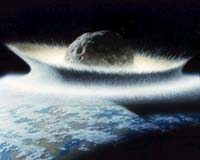
Canberra, Australia (SPX) Aug 08, 2005 A cluster of at least three asteroids between 20 and 50 kilometres across colliding with Earth over 3.2 billion years ago caused a massive change in the structure and composition of the earth's surface, according to new research by ANU earth scientists. According to Dr Andrew Glikson and Mr John Vickers from the Department of Earth and Marine Sciences at ANU, the impact of these asteroids triggered major earthquakes, faulting, volcanic eruption and deep-seated magmatic activity and interrupted the evolution of parts of the Earth's crust. The research extends the original discovery of extraterrestrial impact deposits, discovered in South Africa by two US scientists, D.R. Lowe and G.R. Byerly, identifying their effects in the Pilbara region in Western Australia. "Our findings are further evidence that the seismic aftershocks of these massive impacts resulted in the abrupt termination of an over 300 million years-long evolutionary stage dominated by basaltic volcanic activity and protracted accretion of granitic plutons," Dr Glikson said. The identification of impact ejecta - materials ejected by the hitting asteroid - is based on unique minerals and chemical and isotopic compositions indicative of extraterrestrial origin, including iridium anomalies. The impact ejecta from the Barberton region in the eastern Transvaal indicate the formation of impact craters several hundred kilometres in diameter in oceanic regions of the earth, analogous to the lunar maria basins (large dark impressions on the surface of the moon). The seismic effects of the impacts included vertical block movements, exposure of deep-seated granites and onset of continental conditions on parts of the earth surface. In the Pilbara, the formation of fault escarpments and fault troughs is represented by collapse of blocks up to 250-metres wide and 150-metres high, buried canyons and a major volcanic episode 3240 million years ago. "The precise coincidence of the faulting and igneous activity with the impact deposits, coupled with the sharp break between basaltic crust and continental formations, throws a new light on the role of asteroid impacts in terrestrial evolution," Dr Glikson said. Preliminary indications suggest that at about the same time the Moon was also affected by asteroid impacts and by resurgent volcanic activity. Dr Glikson and Mr Vickers will continue to investigate the extent and effects of large asteroid impacts by studying early terrains in other parts of the world, including India and Canada. Related Links The Australian National University SpaceDaily Search SpaceDaily Subscribe To SpaceDaily Express  Virtual Trip To The Heart Of 400 Million Years Old Microfossils
 Paris, France (SPX) Jul 22, 2005
Researchers from the Universit� de Montpellier II (France), the Institute of Geology of China, and the ESRF have been able to identify enigmatic fossils from Devonian (about 400 million years) as fructification of charophyte algae. |
|
|

| The content herein, unless otherwise known to be public domain, are Copyright 1995-2006 - SpaceDaily.AFP and UPI Wire Stories are copyright Agence France-Presse and United Press International. ESA PortalReports are copyright European Space Agency. All NASA sourced material is public domain. Additionalcopyrights may apply in whole or part to other bona fide parties. Advertising does not imply endorsement,agreement or approval of any opinions, statements or information provided by SpaceDaily on any Web page published or hosted by SpaceDaily. Privacy Statement |