|
 |
 |
 |
 |
 |
 |
 |
 |
 |

| . |  |
. |
German Government A Done Deal
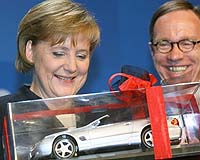
Kehl Am Rhein, Germany (UPI) Nov 11, 2005 Germany's second grand coalition government since the late 1960s got under way Friday after party leaders reached a deal to form a common government. The deal has conservative leader Angela Merkel becoming Germany's first female chancellor. "We want to bring Germany forward," Merkel said Friday at a news conference in Berlin. "And we want to win back the people's trust that the politicians can really achieve something. I am convinced that this coalition treaty allows us to solve the economic and social problems in our country." After the inconclusive Sept. 18 elections, Germany was in political crisis when it appeared the formation of a stable government was unsuccessful. The coalition includes outgoing Chancellor Gerhard Schroeder's Social Democrats and Merkel's conservative alliance of Christian Democratic Union and its Bavaria-only sister party, the Christian Social Union. The new government has the tough job of sparking growth in Europe's largest economy, which at the moment suffers from double-digit unemployment rates. Friday's agreement, shortly before the self-imposed deadline, comes after some last-minute horse-trading on controversial issues such as taxes and the future of the country's nuclear power plants. Merkel pushed through her plan of raising Germany's value-added tax from 16 percent to 19 percent. In return, the conservatives have accepted the SPD's plan to close down all German nuclear power plants by 2021. Ahead of the talks, both camps had vowed to find agreements "beyond the smallest common denominator," while at the same time announcing painful reforms. Germans will have to work up to two years longer, as the country's retirement age will be raised gradually from 65 to 67. The coalition has to find an extra $40 billion to fill holes in the federal budget. Some of the parties' ambitious plans have been discarded, however. Merkel's conservatives had planned to lower non-wage labor costs to attract more domestic and foreign investors. A grand coalition at the moment has no money to follow through with that plan. Wiedelin Wedeking, head of German automobile firm Porsche, reacted furiously: "We have been told nothing but lies, and everyone can feel that today, no matter how much money he makes," he told Saturday's Bild newspaper, in an apparent reference to the coalition's plan to raise the VAT. Industry officials had warned that the measure would hurt already weak consumer spending. Wedeking likely also had in mind a new tax introduced to take money from the rich, a measure Schroeder and colleagues had advertised in the month-long campaign. Singles making more than 250,000 euros ($292,000) will have to pay up to three percent more in taxes. A key coalition architect meanwhile, vowed to tackle such issues later in government. "We know the grand coalition will receive legitimacy from an ability to act," said Franz Muentefering, the future vice chancellor and work minister in Merkel's Cabinet. "In 2006 we will have to begin initiatives in economy and employment. We have resolved several details, but naturally not everything the grand coalition needs to work on has already been written down." Germany's federal pension and health care systems, both ailing after years of neglect, need reforms to survive. The new government is accompanied by a generation change in German politics. Schroeder will retreat to the back benches of politics, and Muentefering is set to hand over the SPD chairmanship to Matthias Platzeck at a party congress next week. Platzeck, like Merkel, hails from former communist East Germany. For the first time since Germany's reunification 15 years ago, two easterners are in charge of the country's biggest parties. The coalition deal still needs to signed off by the major parties, who will convene Monday. There will be heated discussion over the treaty, but SPD and conservative lawmakers are expected to agree to it. Saying no could spell political suicide for the major parties, observers say. "Now we need to get the parties' and the people's support," Wolfgang Thierse, a senior SPD lawmaker, said. "And that might take a while." Related Links SpaceDaily Search SpaceDaily Subscribe To SpaceDaily Express  SPD In Crisis, Coalition Doubts Mount
 Kehl Am Rhein, Germany (UPI) Nov 01, 2005
Germany is in political uncertainty after two key figures in the coalition negotiations announced they might not join the Cabinet, seriously threatening efforts to form a left-right government. |
|
|

| The content herein, unless otherwise known to be public domain, are Copyright 1995-2006 - SpaceDaily.AFP and UPI Wire Stories are copyright Agence France-Presse and United Press International. ESA PortalReports are copyright European Space Agency. All NASA sourced material is public domain. Additionalcopyrights may apply in whole or part to other bona fide parties. Advertising does not imply endorsement,agreement or approval of any opinions, statements or information provided by SpaceDaily on any Web page published or hosted by SpaceDaily. Privacy Statement |