|
 |
 |
 |
 |
 |
 |
 |
 |
 |

| . |  |
. |
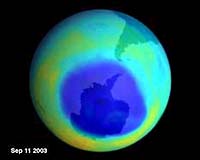
Ozone Hole Third Largest On Record
Geneva (AFP) Oct 18, 2005 This year's seasonal ozone hole over Antarctica was the third largest on record, but forecasters are uncertain how it will behave in the future, the World Meteorological Organisation (WMO) said Tuesday. The hole peaked last month at almost 27 million square kilometers), and then began shrinking as usual, the WMO said in a statement. That was just short of the record 28 million square kilometers) set in 2003, the WMO said. The second-largest hole was logged in 2000. "Because of uncertainties linked to climate change, we don't know if we reached the biggest ozone hole ever in 2003 or if it will be bigger sometime in the future," said WMO ozone expert Geir Braathen. "But it's not likely that it will get much bigger. It seems like we have reached a plateau." "The question is how long it will take before we get back to pre-ozone hole levels," he told reporters. The hole in the ozone layer, discovered in the 1980s, is created by atmospheric conditions and pollution, and fluctuates according to season and prevailing weather. Ozone, a molecule of oxygen, is a stratospheric shield for life on Earth, filtering out dangerous ultraviolet rays from the Sun that damage vegetation and can cause skin cancer and cataracts. The protective layer has been increasingly damaged by man-made chemicals, especially bromine, chlorine and chlorofluorocarbons (CFCs). CFCs are an aerosol gas, previously used in refrigerators, whose use was belatedly controlled by an international treaty, the Montreal Protocol signed on September 16, 1987. "As the amount of chlorine and bromine will continue to decline over the next decade -- very slowly -- one expects the ozone whole to get smaller and smaller," Braathen said. "But at the same time there is also this issue of climate change, which leads to high temperatures on the ground while in the stratosphere temperatures will decrease. And that will encourage more ozone loss in the Arctic and Antarctic." "This is an open question. We don't know what the effect will be." Related Links SpaceDaily Search SpaceDaily Subscribe To SpaceDaily Express  South Polar Ozone Hole Makes Big Comeback
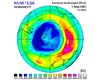 Paris (ESA) Aug 31, 2005
This season's Antarctic ozone hole has swollen to an area of ten million square kilometres from mid-August - approximately the same size as Europe and still expanding. It is expected to reach maximum extent during September, and ESA satellites are vital for monitoring its development. |
|
|

| The content herein, unless otherwise known to be public domain, are Copyright 1995-2006 - SpaceDaily.AFP and UPI Wire Stories are copyright Agence France-Presse and United Press International. ESA PortalReports are copyright European Space Agency. All NASA sourced material is public domain. Additionalcopyrights may apply in whole or part to other bona fide parties. Advertising does not imply endorsement,agreement or approval of any opinions, statements or information provided by SpaceDaily on any Web page published or hosted by SpaceDaily. Privacy Statement |