
 |
 |
 |
 |
 |
 |
 |
 |
 |
 |

| . |  |
. |

Corvallis OR (SPX) May 17, 2011 They can be both a blessing and a curse, and have been around since the dawn of life. Thousands of species are found from mountain tops to smoking volcanic vents on the ocean floor. They play a key role in soil biology and help to support much of the plant and animal life on Earth. But until now, no one knew when or where they came from. And to a large extent, no one cared. Such has been the fate of the hugely important but little appreciated animal known as the nematode, or roundworm. That has changed with a new book from Oregon State University, "The Evolutionary History of Nematodes," that establishes for the first time the field of palaeonematology - the study of the ancient history, origin and evolution of these tiny creatures from our distant past. More information on the book is available online at here. "A farmer usually just thinks about how to kill them, because some nematodes are parasites of crops," said George Poinar, author of the book and an OSU courtesy professor of zoology. "Geneticists have a little more respect, because one nematode, C. elegans, is very useful in modern genetic research. And helpful nematodes could become important in the future of organic and sustainable agriculture. "About the only time most people care about nematodes is when they become infected with a species such as hookworms," Poinar said. "That's been going on a long time. The ancient Egyptians had treatments for worms, some of which were pretty horrible. One of them entailed eating goat feces." At some universities, Poinar said, there are entire departments devoted to the study of nematodes - again, mostly on how to kill them. But almost nothing until now had been done to learn about their origins, in part because the tiny, soft bodies of nematodes are rarely found in fossils. Their history was a mystery. Poinar, however, is one of the world's leading experts in the study of ancient life forms found in amber, a semi-precious stone formed from tree sap. It has the unusual ability of preserving ancient plant and animal life forms in near perfect condition. Through nematodes found in amber, as well as some fossils and even odd sources like Egyptian mummies, Poinar has created a foundation for the study of nematode evolution. "The oldest known nematodes are from about 400 million years ago, but I believe they probably date back to around 1 billion years," Poinar said. "That would mean they were one of the very oldest of all life forms, coming along before almost all other animals and just after bacteria, protozoa and fungi. "They literally emerged from the primordial ooze," he said. Nematodes are usually very small, and the smallest are microscopic. But they are functional animals, with nervous and digestive systems, muscles, good mobility, and they are capable of rapid reproduction and learned behavior. They are hardy survivors, able to live in freshwater, marine and terrestrial environments, and may comprise as much as 90 percent of all life forms on the ocean floor. There are tens of thousands of species described, but there may be up to 10 million overall. There are 138 species known to infect humans, most of which were passed along as a dubious gift from our primate ancestors. Based on his research, Poinar believes nematodes evolved in the sea and one of their first roles was as a parasite to marine invertebrates. They make great parasites. One species causes heartworms in dogs, another is the most infectious agent in sheep around the world. As plant parasites they can cause severe crop losses, often feeding on roots. But at the same time they are an important "secondary decomposer" in soil biology. And some nematodes can be used in organic insect control - a key role that may allow reduced use of pesticides. "There's still a huge amount we don't know about nematodes," Poinar said. "But these are one of the most important invertebrate groups on Earth, and the new discoveries of fossil roundworms discussed in the book help to fill in the gaps about how ancient nematodes really are. It's a good start."
Share This Article With Planet Earth
Related Links Early Earth at Oregon State Explore The Early Earth at TerraDaily.com

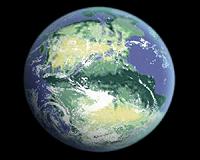 Latitude and rain dictated where species lived
Providence RI (SPX) May 16, 2011 Aggregating nearly the entire landmass of Earth, Pangaea was a continent the likes our planet has not seen for the last 200 million years. Its size meant there was a lot of space for animals to roam, for there were few geographical barriers, such as mountains or ice caps, to contain them. Yet, strangely, animals confined themselves. Studying a transect of Pangaea stretching from about thre ... read more |
|
|
| The content herein, unless otherwise known to be public domain, are Copyright 1995-2010 - SpaceDaily. AFP and UPI Wire Stories are copyright Agence France-Presse and United Press International. ESA Portal Reports are copyright European Space Agency. All NASA sourced material is public domain. Additional copyrights may apply in whole or part to other bona fide parties. Advertising does not imply endorsement,agreement or approval of any opinions, statements or information provided by SpaceDaily on any Web page published or hosted by SpaceDaily. Privacy Statement |


 del.icio.us
 Digg
Digg Reddit
 YahooMyWeb
 Google
 Facebook







