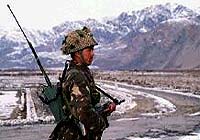
and which useless piece of mountain were we fighting over
and which useless piece of mountain were we fighting over |
This will be the first face-to-face meeting between Pakistani officials and India's newly elected officials of the Congress Party, who have inherited a derailed peace process with Islamabad.
Singh would meet his Pakistani counterpart Khursheed Mehmood Kasuri on the sidelines of the July 21-22 regional summit of south Asian nations of which Pakistan is the current chairman.
The two foreign ministers spoke on phone Sunday and pledged to carry forward the peace process in every area and contacts would be further intensified.
Singh said both sides had "vested interests" in promoting bilateral relations. "We hold Pakistani leadership in the highest esteem," Indian foreign minister said.
During the conversation, Singh also quoted an Urdu couplet, which translates to "at least we are seeing a happy dream, a dream towards which we did not see till now."
India's Congress Party, which wrested government from the Hindu nationalist Bharatiya Janta Party in last month's federal elections, was in power when India and Pakistan fought three wars over the last 55 years.
Natwar Singh told Kasuri that the "future of India-Pakistan relations does not lie in the past."
"Expressing full respect for responsible media on both sides, the two leaders agreed that distortions in the media should be ignored," India's foreign ministry spokesman Navtej Sarna said.
Pakistan President Pervez Musharraf has said that the culture of issuing statements had gained momentum since Prime Minister Manmohan Singh's government came to power.
Despite verbal skirmishes in the last few days, both Islamabad and the new administration in Delhi have been warming up to each other. Both sides have reaffirmed their commitment to continue with the confidence-building measures aimed at a peaceful solution to the five decades of war and mistrust.
Kasuri would also visit India in August, The News daily reported.
The foreign ministers meeting would follow a conclave of senior officials from both nations on the nuclear confidence-building measures on June 19 and 20. Foreign secretaries of the two sides would meet on June 27.
The Indian minister would also pay a courtesy call to President Musharraf and Prime Minister Mir Zafarullah Khan Jamali.
A series of confidence-building measures have been introduced over the past year, including a resumption of rail, air and bus links and a strengthening of diplomatic ties. The Indian cricket team also traveled to Pakistan earlier this year, despite security concerns.
However, a word of caution has come to India from the former Pakistani prime minister Nawaz Sharif, who was ousted by Gen. Pervez Musharraf in a bloodless coup in October 1999.
Sharif, who lives in exile in Saudi Arabia, warned India "not to trust Gen. Musharraf."
Sharif had launched the peace process with his then Indian counterpart Atal Behari Vajpayee in 1999.
"We shared a genuine rapport. I want to tell you that Vajpayee and I had planned 1999 as a year of peace. But it was not to be. If I had stayed on for another year, we would have resolved everything," Sharif told Indian Express in an interview in Jeddah, Saudi Arabia.
"Vajpayee and I would have resolved the Kashmir issue. But Gen. Musharraf betrayed me. He betrayed Vajpayee as well," the daily quoted him as saying.
"India should be careful about trusting the general. He is a dangerous man," Sharif said. The former premier has been living in exile for the last four years after he spent 14 years in a Pakistani jail. Saudi Arabia brokered his release.
India and Pakistan have shared more than five decades of mistrust, hostility and war over the mainly Muslim Himalayan region of Kashmir. The region, divided between the neighbors since 1947, has sparked two of the three wars.
All rights reserved. Copyright 2004 by United Press International. Sections of the information displayed on this page (dispatches, photographs, logos) are protected by intellectual property rights owned by United Press International. As a consequence, you may not copy, reproduce, modify, transmit, publish, display or in any way commercially exploit any of the content of this section without the prior written consent of by United Press International.
Related Links
 India, Pakistan Survive Verbal Scare
 New Delhi (UPI) Jun 02, 2004