|
 |
 |
 |
 |
 |
 |
 |
 |
 |

| . |  |
. |
300 Million Chinese Drinking Harmful Water Because Of Pollution: Official
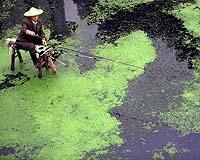
Beijing (AFP) Dec 22, 2004 Some 300 million people are drinking unsafe or harmful water because more than 70 percent of China's rivers and lakes are polluted, a top government official said Wednesday. Wang Shucheng, minister of water resources, issued the grim warning at a national conference for directors of water resources bureau in the eastern city of Suzhou, the Xinhua news agency said. "Currently, 300 million Chinese people are drinking unsafe water, among which 190 million are drinking water with harmful substances above set standards," Wang said. The Chinese government has allocated more than 18 billion yuanbillion US dollars) to build 800,000 drinking water projects in rural areas since 2000 and has set the lofty goal of providing safe drinking water to every rural family by 2020, although it has yet to work out how it will do so. But many people in the countryside still lack safe drinking water, Zhai Haohui, vice-minister of water resources, was quoted as saying. "More than 63 million peasants living in north, northwest, northeast and east China plains are drinking water with fluorine above set standard," he said. Fluorine is a toxic chemical element. In addition, 60 million people in 110 counties of Hunan, Hubei, Jiangxi, Anhui, Jiangsu, Sichuan and Yunan provinces are threatened by schistosomiasis, a parasitic disease, Zhai said.
One Of North China's Largest Lakes Dries Up In other news effecting China's freshwater, one of the countrys' largest northern lakes has dried up, threatening the survival of rare birds, state media said Wednesday Anguli Nur lake, in Hebei province neighboring Beijing, was once four meters (13 feet) deep and covered 6,000 hectares (14,820 acres), the Xinhua news agency said. But continuous drought and over-exploitation of water by the Bashang area of nearby Zhangjiakou city caused the lake to dry up, Xinhua said. Lack of water in the lake will likely endanger 10,000 hectares of surrounding grassland, local residents said. For centuries the lake also served as a major habitat of birds and fish, including some rare species of aquatic birds, the report said. The area was an imperial summer resort and hunting ground more than 1,000 years ago. Related Links SpaceDaily Search SpaceDaily Subscribe To SpaceDaily Express  China Helps Track French Satellite's Orbit
 Beijing (XNA) Dec 21, 2004
Satellite observation and control networks in China and France yesterday successfully tracked the orbiting of a satellite launched by the French Government. |
|
|

| The content herein, unless otherwise known to be public domain, are Copyright 1995-2006 - SpaceDaily.AFP and UPI Wire Stories are copyright Agence France-Presse and United Press International. ESA PortalReports are copyright European Space Agency. All NASA sourced material is public domain. Additionalcopyrights may apply in whole or part to other bona fide parties. Advertising does not imply endorsement,agreement or approval of any opinions, statements or information provided by SpaceDaily on any Web page published or hosted by SpaceDaily. Privacy Statement |