|
 |
 |
 |
 |
 |
 |
 |
 |
 |

| . |  |
. |
AMEC Designed BLAST Telescope Lands Safely On Victoria Island
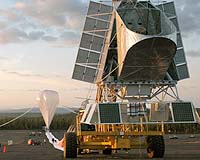
Washington DC (SPX) Jun 17, 2005 The AMEC designed BLAST telescope landed successfully Thursday morning at 2:15 am (EDT) on Victoria Island in the Canadian Arctic. "It appears that BLAST's gondola passed its greatest test," said AMEC's David Halliday, Vice President (Dynamic Structures). "The recovery team reports that the gondola kept the instrumentation and the universe's birth data intact after dropping from 25 miles above Earth." AMEC, the international project management and technical services company, designed and fabricated the telescope as well as its re-usable gondola and directional sighting system which worked flawlessly. BLAST was launched in northern Sweden and was scheduled to fly for 5-9 days. However, it landed earlier, 4 days and 1 hour after take-off, due to winds carrying it on a northern flight path. Had the flight continued, BLAST would have been carried across the Arctic Ocean. "Victoria Island is our point of no return," explained Danny Ball, Site Manager for the National Scientific Balloon Facility. "Because the island is so large, it was a great place to land BLAST." Located in Texas, Ball remotely released BLAST from its balloon, where it fell via parachute 125,000 feet. It took approximately 45 minutes for BLAST to reach the ground. Ball adds, "It's in excellent condition. BLAST is the prettiest thing we ever flew. AMEC's gondola is really amazing. The payload is dry and still transmitting." Recovery will begin this morning with a heavy lift helicopter travelling to the location 179 miles northwest of Cambridge Bay. BLAST stands for Balloon-borne Large Aperture Submillimeter Telescope; the balloon's volume is the size of a 33 storey building. Never before has this level of scientific equipment been flown suspended by a balloon. The data gathered with BLAST will be used with information to be received by the Atacama Cosmology Telescope, which is currently being designed and fabricated at AMEC's facility in Port Coquitlam, British Columbia. Known as the 'Big Bang' telescope, AMEC will construct Atacama Cosmology Telescope in the high desert in Chile next year.
Related Links  Boston MA DC (SPX) Jun 17, 2005
The Submillimeter Array (SMA) will be ready and watching when NASA's Deep Impact probe strikes the nucleus of Comet Tempel 1 on July 4th. The impact is expected to excavate material from the comet's interior-material left over from the earliest days of our solar system.
--------------------------------------------------------- It's new. And it's downright terrific! Celestron's CPC Schmidt-Cassegrain telescope is the scope you've been waiting for! It offers new alignment technology, advanced engineering, and bold new design at a new, low price! In fact, Celestron's Professional Computerized (CPC) scope with revolutionary SkyAlign Alignment Technology redefines everything that amateur astronomers are looking for. It offers quick and simple alignment, GPS technology, unsurpassed optical quality, ease of use, advanced ergonomics, enhanced computerization and, most important, affordability. Want to view M-31 tonight? One button takes you there!
Shop for telescopes online at Telescopes.com! today!
|
|
|

| The content herein, unless otherwise known to be public domain, are Copyright 1995-2006 - SpaceDaily.AFP and UPI Wire Stories are copyright Agence France-Presse and United Press International. ESA PortalReports are copyright European Space Agency. All NASA sourced material is public domain. Additionalcopyrights may apply in whole or part to other bona fide parties. Advertising does not imply endorsement,agreement or approval of any opinions, statements or information provided by SpaceDaily on any Web page published or hosted by SpaceDaily. Privacy Statement |