|
 |
 |
 |
 |
 |
 |
 |
 |
 |

| . |  |
. |
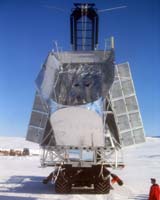
A Blast Over Antarctica As Telescope Soars
Longueuil, Canada (SPX) Jan 01, 2007 A fascinating experiment is being conducted this week over Antarctica by Canada and its partners, the U.S., the U.K. and Mexico. Attached to a huge helium balloon, 2,000-kilogram BLAST (balloon-borne large aperture sub-millimetre telescope) is peering deep into space to study distant stars and galaxies. Launched from the McMurdo Research Station in Antarctica on December 21, BLAST is expected to fly for up to 10 days, circling 38,000 metres above the frozen continent in the stratosphere. The two-metre telescope offers levels of sensitivity and resolution unmatched by any observation facility on Earth. The mission will shed light on fundamental questions about the formation and evolution of stars and galaxies. BLAST will identify large numbers of distant star-forming galaxies, study the earliest stages of star and planet formation, and make high-resolution maps of diffuse galactic emissions. Canada is providing the gondola, the pointing control system, the data acquisition system, the flight and ground station software, the power system, and overall system integration. Canadian partners in this project include the University of Toronto, the University of British Columbia, and AMEC Dynamic Structures Ltd. of Port Coquitlam, B.C. Canadian funding was provided by the Canadian Space Agency, who contributed $2 million for equipment and mission operations, the Natural Sciences and Engineering Research Council of Canada (NSERC), the Canada. Foundation for Innovation, the Ontario Innovation Trust, and the University of Toronto. International partners include the University of Pennsylvania, Brown University, the University of Miami, the Jet Propulsion Laboratory, Cardiff University, and the Instituto Nacional de Astrofisica of Mexico, with funding from NASA and the U.K.'s Particle Physics and Astronomy Research Council (PPARC). Related Links More at Canada Space All about the technology of space and more  Europe Looks Forward To COROT Launch
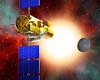 Paris, France (ESA) Dec 20, 2006
On 27 December, COROT is to be launched into space on a unique astronomy mission: its twin goals are to detect exoplanets orbiting around other stars and to probe the mysteries of stellar interiors as never before. COROT is a French national space agency (CNES)-led mission to which the European Space Agency and European partners are adding a particularly strong international flavour. |
|
|

| The content herein, unless otherwise known to be public domain, are Copyright 1995-2006 - SpaceDaily.AFP and UPI Wire Stories are copyright Agence France-Presse and United Press International. ESA PortalReports are copyright European Space Agency. All NASA sourced material is public domain. Additionalcopyrights may apply in whole or part to other bona fide parties. Advertising does not imply endorsement,agreement or approval of any opinions, statements or information provided by SpaceDaily on any Web page published or hosted by SpaceDaily. Privacy Statement |