
 |
 |
 |
 |
 |
 |
 |
 |
 |
 |

| . |  |
. |
After Olympics, China eyes space conquest
Beijing (AFP) Sept 24, 2008 Flushed with success after a widely applauded Beijing Olympics, China will seek this week to further burnish its image with a new chapter in its quest to conquer space. Long-time Communist Party member Zhai Zhigang is slated to become the nation's first "taikonaut" to walk in space during the Shenzhou VII mission, China's third manned space flight, which is slated to blast off Thursday night. "When you can undertake manned space flight, you get prestige," Philippe Coue, author of several works on China's space programme, told AFP. "If all goes well, especially after the Olympic Games, the nation's image will be even further embellished." In a matter of years, China's military-run space programme has made strides which the United States and Russia took decades to accomplish, and even though the budget is a secret, it is clear it has done so at much smaller cost. "They have gone very fast, they had the will to undertake manned space flight and they went directly to a sophisticated design capable of carrying three astronauts," Coue said of the three-man Shenzhou mission. The nation's first space walk is part of a series of step-by-step flights which aim to culminate in an orbiting space laboratory over the next several years and then a permanent space station. China became the third nation after the former Soviet Union and the United States to independently send a man into orbit after Yang Liwei was blasted into space on Shenzhou V in 2003. Following Yang's solo flight, two astronauts manned the Shenzhou VI for a five-day flight in 2005. By 2017, China could be circling the moon in a manned mission and land on the lunar surface by 2025. Beginning in 2015, China hopes to begin the exploration of Mars. Forty-two years after Yuri Gagarin became the first human in space, Yang was welcomed home as a hero by the nation of 1.3 billion, where the dream of space flight is as old as the Ming Dynasty (1368 to 1644 AD). According to one legend, the Ming official and amateur astronomer Wan Hu tried to construct a crude spaceship -- basically a chair with dozens of rockets attached to it -- and may not have survived his attempt to enter orbit. While playing a bigger and bigger role on the world's economic, financial and political stage, China also showed its sporting prowess by dominating the Beijing Olympics. Now it hopes to further its grand vision for outer space. "The Chinese say: 'We want to be seen as a leading technological power and the way to do that is through space,'" Isabelle Sourbes-Verger, a researcher and expert on China's space programme, told AFP. Some experts believe that outer space will become the new battleground in an emerging rivalry between an increasingly confident China and the United States. "The Chinese space programme is more a question of affirming its own capabilities than a rivalry. It's the United States that is posing the question of a rivalry," Sourbes-Verger said. Although some members of the US Congress have expressed concern about China's growing ambitions in space, NASA's huge budget -- 17.3 billion dollar this year alone -- will ensure American domination for a long time to come. Even so, China has already surpassed Japan as the most powerful space nation in Asia, and is far ahead of fledgling space power India too. "China has sent a man into space largely by itself, while Japan depends on the United States," said Sourbes-Verger. But for China, it is the prestige that remains a driving force in its programme, experts say. "Certainly, a space programme shows the economic and scientific power of a nation," said Hu Xingdou, professor at the Beijing Institute of Technology. "Currently more and more nations are capable of launching satellites, but very few have succeeded in going to outer space." So far, China's space authorities have shown nothing but confidence in the success of the flight of the Shenzhou, or "divine vessel," and are already beginning preparations to recruit a second generation of taikonauts. Community Email This Article Comment On This Article Share This Article With Planet Earth
Related Links The Chinese Space Program - News, Policy and Technology China News from SinoDaily.com
 Shenzhou 7's Mystery Top
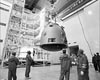 Sydney, Australia (SPX) Sep 24, 2008
Most of the mysteries surrounding the Shenzhou 7 mission have now been solved through media disclosures and some deductive reasoning on the part of analysts. But there's one outstanding mystery. We don't know exactly what is sitting on top of the Orbital Module of the Shenzhou 7 spacecraft. |
|
|

| The content herein, unless otherwise known to be public domain, are Copyright 1995-2007 - SpaceDaily.AFP and UPI Wire Stories are copyright Agence France-Presse and United Press International. ESA Portal Reports are copyright European Space Agency. All NASA sourced material is public domain. Additional copyrights may apply in whole or part to other bona fide parties. Advertising does not imply endorsement,agreement or approval of any opinions, statements or information provided by SpaceDaily on any Web page published or hosted by SpaceDaily. Privacy Statement |
 del.icio.us
 Digg
Digg Reddit
 YahooMyWeb
 Google
 Facebook